An Educational Service for Clinical & Forensic Psychiatrists, Psychologists, Other Forensic and Mental Health Professionals, Attorneys, and Judicial Professionals (Students & Trainees Welcome!)
William
H. Reid, M.D., M.P.H.
Forensic
Psychiatry Consultant
Horseshoe Bay, Texas
SCROLL DOWN for MAIN MENU, Updates, and Abstracts
Last Updated January, 2021 -- Look for  icons.
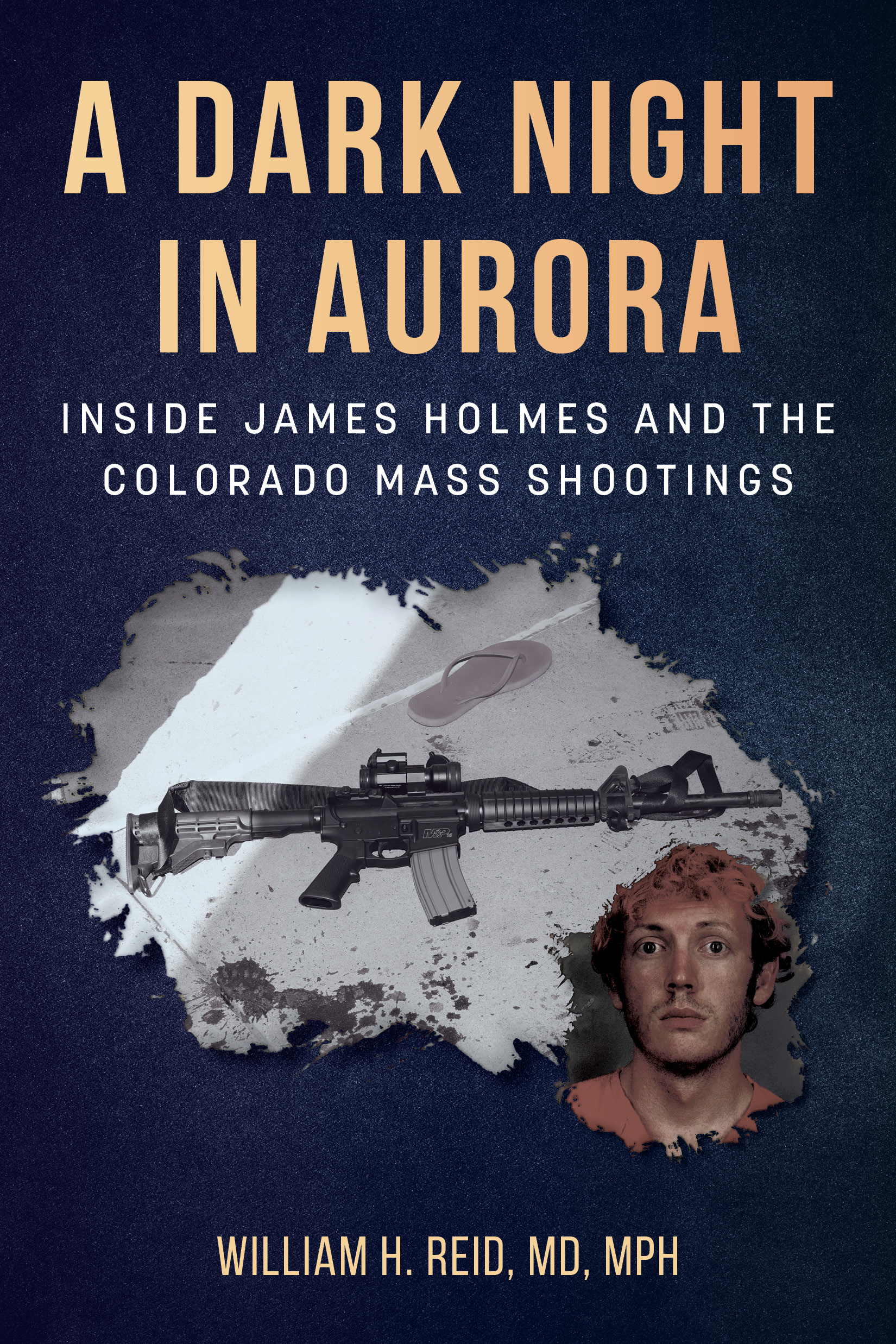
NOW IN PAPERBACK
"Stunning, scrupulous, and relentlessly gripping . . . a triumphant work of investigative nonfiction . . . Reid is brilliant—as deft a storyteller as he is a scientific communicator."
--Daniel J. Patinkin, author of The Trigger: Narratives of the American Shooter
"A Dark Night in Aurora is true crime writing at its best." —Park Dietz, MD, MPH, PhD
Available at
Amazon.com and wherever you buy books (print, Kindle/ebook, audiobook).
(Click HERE to order from Amazon.com)

NOTE (2020) teaching additions, and links to our other sites, in the main menu below: handouts/slides for psychiatric trainees on Advance Directives, Clinicians Testifying in Court, When to Call a Forensic Psychiatrist, and Malpractice and Being Sued for it written to be adapted to general psychiatry residency programs. There are also two slide presentations on suicide risk, one largely for psychiatrists and psychiatric trainees (Suicide Risk); the other for emergency room and primary care clinicians (Asking the Patient is Not Enough). I'll soon post an eight-session classroom curriculum and syllabus for teaching forensics in U.S. general psychiatry training programs and doctoral clinical psychology programs, and a slide show (slide deck) on forensic psychiatry careers designed for medical students. I encourage the use of these resources in clinical teaching and to improve patient safety, particularly in hospital settings, but note that these syllabi and slide shows are copyrighted; please give appropriate author credit and DO NOT republish them in print or digital form without my permission (available at the email address above).
Also, I've recently culled the Links page to remove obsolete and (a few) ittitating ones. Nonprofit mental health services can contact me by email to request inclusion. (NO brokers or referral websites/services please!)
If you're a high school or college student working on a paper or project, or interest in career information, please check out our STUDENT & TRAINEE FAQ in the main menu below before contacting me. If your questions aren't answered, feel free to email me.
Note: The material on this website is often greatly summarized or excerpted. It should not be considered complete or exhaustive. Legal concepts are informal, reflect Dr. Reid's general understanding, and are not necessarily official positions of any court, litigating party, government, or other body. Comments welcome! Email to Dr. Reid's office, or see the contact information at the bottom of this page.
Content and concept copyright (c) 1998-2021 by William H. Reid, M.D., M.P.H., unless otherwise assigned. Full-text material from The Journal of Psychiatric Practice is copyrighted by Lippincott Williams & Wilkins, and used with permission.
SITE SEARCH for your research convenience |

Schreiner University, in the Texas Hill Country city of Kerrville, offers undergraduate and graduate degrees, pre-professional studies (pre-med, pre-vet, pre-law), BSN (nursing) and online RN-to-BSN programs, fine and performing arts, elite military academy preparation, and much more (including recent national championship golf and shooting teams!). As a member of the Board of Trustees, I fully endorse Schreiner for its quality of education, personal and family values, individual student attention, a very favorable cost-to-value ratio, great food & dorms, and a COVID-safe environment with both in-person and remote learning! Go to Schreiner.edu.
Support-A-Soldier A 501(c)(3) charitible organization (my brother is Board chair) providing requested gear to U.S. soldiers at the “tip of the spear” in foreign deployments. Our combat troops are asked to do more and more, often with less and less material support. You can help in several ways, (1) by letting deployed soldiers know about the website (www.supportasoldier.com) so they can request items (at no cost), (2) by spreading the word, and, of course, (3) by donating at the website or the address provided there. THANK YOU! |
Current & "Basic" Updates and Full-Text Articles
Covid-19 link(s) coming soon.
Return to Current Table of Contents
Class Action Suit Over Denied Mental Health Services
It didn't make the national news, but the fight for access to psychiatric care, and insurance "parity" for a great many psychiatric patients is a little closer to being won. The second U.S. Court of Appeals ruled in September, 2016, that third party administrators of health care insurance plans (such as UnitedHealthcare) can be sued for allegedly illegally restricting plan members' access to residential and outpatient treatment. The ruling allows such allegations to be pursued as class actions in addition to individual lawsuits, the latter being prohibitively expensive for the vast majority of patients and their families.
Plan members had sued UnitedHealthcare and United Behavioral Health (a subsidiary) under the federal Employee Retirement Income Security Act (ERISA), for creating and promulgating defective and overly restrictive acceptance (read "payment") guidelines for a number of psychiatric services. United Behavioral Health is the largest mental health care insurer in the United States, with plans that cover over 60 million subscribers.
There's a complete article about the decision in Modern Healthcare at http://www.modernhealthcare.com/article/20160920/NEWS/160929989
Return to Current Table of Contents
Treatment of Psychopathy and Antisocial Syndromes
Some colleagues and I recently completed a book chapter on the treatment of severe antisocial syndromes (including antisocial personality and psychopathy). It's not my first rodeo (as we say here in Texas). I've written about psychopaths, asocial people, and those whom courts and the press call the "criminally insane" for decades. I've evaluated a great many, treated some, and overseen the treatment of scores, maybe hundreds. The treatment field for these people and their disorders has some promising features, even though the general picture is usually considered bleak.
The end of our chapter remembers a great and kind man whose call should be heard widely and often among mental health professionals, particularly those who work in correctional settings and forensic hospitals:
Many years ago, I met with Dr. Georg Stürup in his Randers, Denmark, home. Dr. Stürup, now deceased but then the retired superintendent of Herstedvester Institution, author of Treating the Untreatable (Baltimore, MD: Johns Hopkins Press, 1968), and a tireless worker to change some of his country's most reviled, severely antisocial people, was still enthusiastic, but bent with age. Knowing that his decades of work “treating the untreatable” were over and he was losing his international forum of advocacy, he said to me, "Don’t forget these people. They have no one, yet they are people. They are desperately lacking and in terrible pain. Those who understand this are so rare; you must not turn your back on them."
Those who labor in these fields have our admiration, and our hope that their work someday will bear lasting fruit.
Return to Current Table of Contents
Assessing Social Security Payee Competency
Dr. Mark Amdur recently published a useful group of "pearls" for the sometimes-vexing problem of assessing whether or not a person is competent to be the payee for his/her own social security disability payments. Dr. Amdur's brief article refers mainly to treating physicians, such as psychiatrists and primary care doctors, who deal with such questions (on form SSA-787) with every Social Security disability evaluation, but the principles often apply to independent medical examinations (IMEs) by psychiatrists and psychologists, and to other kinds and sources of payments.
He lists a number of situations under which a separate payee may be required (and should be considered). They include clinical ones such as dementia, intellectual limitation, other brain deficits, manic spending, depressive withdrawal, psychosis, and substance abuse, as well as behavioral problems often associated with financial incompetence (chronic serious debt or bankruptcy, gambling, homelessness, failure to cash checks, severe hoarding, etc.)
Patients/evaluees whose competency is questioned often become demanding, even belligerent. Confrontations about payeeship and money in general can be difficult, even violent. More than one family member has been injured (even killed) by a paranoid or otherwise-incensed patient demanding "my money."
Dr. Amdur notes that when he considers recommending a third-party payee, he often suggests a three-month trial in which the patient/beneficiary receives his/her own payments but is monitored by family or some other caregiver. If all goes well during that time, he is comfortable signing the SSA-787.
Today's doctor-patient relationships encourage autonomy, but clinicians and evaluators should not be reluctant to explore – and recommend when appropriate – alternative payeeship when it is clearly in the patient's/evaluee's interest. (Amdur MA [2015]. "It's my money and I want it now!" Clinical variables related to payeeship under Social Security. Current Psychiatry 14[9]:53-54)
Return to Current Table of Contents
Patients, Email, and Legal Risks
Many clinicians, especially those approaching my age, are still concerned about whether -- and how -- to use email for various kinds of patient communication. Lots of professional organizations, including the American Psychiatric Association, recognize the utility of email, but specify that it must be used properly. A recent article by Drs. Annette Reynolds and Douglas Mossman provides helpful guidance.
Psychiatrists, psychologists, and other professionals should already know to be cautious with patient-related email and texting, but patients themselves often initiate risky email communication, sending doctors and therapists detailed, confidential, or time-sensitive information in the unwarranted belief that their email will only be seen by the clinician, and will be read at once. When one receives such messages, it's a good idea to respond generically that such topics will not be discussed or considered by email or text, highlight the confidentiality risks (and others; see below), and require a telephone or face-to-face interaction in order to proceed.
First, the security issues. Neither the clinician nor the patient knows who may have access to unencrypted email. One may be not be communicating with the patient at all, but with a family member or friend using his computer. Server operators can – but usually don't – intercept and read messages. At the clinician's end, unless precautions are taken, emails may be opened and read by office staff and others. And we all know about illegally "spoofed" email addresses. At the least, clinicians should have a dedicated professional email account that is not combined with other uses. Better: use an encryption method and educate your patients in its use.
Get patients' explicit (written is best) consent before using email communication. That consent should, among other things, notify the patient of the security risks, discuss expected reading and response times, outline what is and is not appropriate for both subject lines and the body of messages, and disclose who has known access to your email account. Let patients know that they must not rely on email for things like urgent matters and sensitive or confidential topics. Anything that requires multiple email exchanges should probably be addressed in person or by phone.
Reading and response time is a big deal. Both doctors and patients must understand that there is no assurance that an email will be promptly read and dealt with. Automatic "received and opened" notices are helpful, but still don't guarantee that the doctor or patient himself/herself read the message.
Finally, remember that email or text communication creates the same clinician duties and responsibilities as does any other form of communication. Answering clinically-related emails from a non-patient may inadvertently create a new doctor-patient relationship, with all its attendant duties. Information given, responses considered, and decisions made on the basis of email communication must comply with clinical standards of care.
Read the article for yourself; it's shorter than the page numbers imply. (Reynolds A, Mossman D [2015]. Before you hit "SEND": Will an email to your patient put you at legal risk? Current Psychiatry 14[6]:33-42)
Return to Current Table of Contents
Stop Avoidng ECT for Suicidal Patients
I continue to be very disappointed that acutely depressed and suicidal patients rarely have opportunity for electroconvulsive therapy (ECT). In my malpractice cases that involve suicide – the majority of such cases and the number one malpractice cause of action against psychiatrists and psychiatric hospitals – ECT, one of the fastest, best and safest treatments, has rarely been adequately considered.
The psychiatric literature is currently touting ketamine treatment for major depressive episodes. In spite of lack of proof of lasting benefit, and being fraught with potential for adverse effects, some authors want to place a ketamine trial before ECT in treatment algorythms. Other authorities – cooler heads, in my view – don't recommend that (see, e.g., Schatberg AF [2014]. A word to the wise about ketamine. Am J Psychiatry 171:262-264). Kellner and others, experts in ECT, succinctly outline the fact that ECT is a proven, standard treatment; ketamine is not (Kellner et al. [2014]. Am J Psychiatry 171[7]: 796).
Failure to adequately consider ECT in acute, potentially suicidal depression is routinely below the standard of care. This treatment saves lives, and an ECT consultation goes a long way toward showing that the treating clinician has exercised good judgment in patient care and risk mitigation.
Return to Current Table of Contents
Assessing Risk of Violence: Don't Be DISTURBED
I recently read an article that brought up an old, but continuing, problem inherent in acronym-based checklists for assessing violence risk (or risk of suicide for that matter). The problem: Such acronyms rarely differentiate highly important or critical risk factors from those that are much less useful.
Without meaning to castigate Drs. Newman and Xiong, who were no doubt trying to encourage clinicians to think about a broad range of risk factors when evaluating patients or clients for violence risk, their acronym – DISTURBED – unfortunately mixes important risk factors with relatively unimportant ones, and doesn't prioritize the items. Some of their factors are virtually useless when assessing individual risk (as contrasted with statistical risk among large groups). For example, demographics (the "D" in DISTURBED) refers to age, gender, education, financial hardship, etc., all of which, while correlated with violence, are poor – and unfair – predictors of individual violent behavior. Correlation, after all, is a large-group statistic. Further, correlations of violence with the demographics mentioned are generally low (although positive) anyway.
That's a lot of false positives. It's also an opportunity to downplay real risk in people who don't fit the demographic model.
My point is that if one is trying to assess individual risk of violence, or trying to develop a screening instrument to help in that effort, it is crucial to pay far more attention to factors that are very highly correlated with violence (and often should simply block out less important factors) than to those with little predictive value in one person. In addition, anyone asked to evaluate risk of violence should first ask what kind of violence is being contemplated, and in what context.
People take risk evaluators seriously; let's be careful out there.
(The article referred to above is Newman W, Xiong GL [2014]. Take caution: look for DISTURBED behaviors when you assess violence risk. Current Psychiatry 13[8]:13-14.)
Return to Current Table of Contents
Cognitive Behavioral Therapy (CBT), Suicide Prevention,
and Risk Reduction for Both Patients and PsychiatristsSuicide is far and away the most common cause of action in malpractice lawsuits against psychiatrists and other mental health clinicians and entities. The civil portion of my forensic practice is filled with clinicians accused of being negligent in assessing or managing suicide risk, whose alleged negligence allowed – or was said to have caused – a preventable suicide. The most vulnerable defendants are those who fail to provide adequate assessment and protection for patients at acute risk, but I am continually amazed at the number of both acutely and chronically suicidal patients who don't receive the psychotherapy that could really help them, could lower their risk, and could decrease their psychiatrists' risk of malpractice suits and the heartache that comes from having a patient kill himself or herself.
The fact is, competent counselors and psychotherapists should know the kinds of therapy that often work with suicidal patients. The research is there, and has been well-known for many years. Good training programs teach it. Continuing education programs regularly feature the counseling techniques that can save lives (and save quality of life). It's just not rocket science!
Cognitive-behavioral therapy (CBT) is one of the best, most reliable, and most studied treatment formats for many suicidal patients, and for many of the disorders – such as severe depression and anxiety – associated with suicide. A quick search of the professional literature (try the National Library of Medicine at http://www.ncbi.nlm.nih.gov/pubmed) reveals scores of articles and studies that illustrate its effectiveness. Yet few of the hospitals or clinicians whose suicide-related cases I review have used CBT, or used it competently.
Here's what I'm not talking about: I'm not talking about the kind of counseling or so-called "therapy" that most hospitals and many practitioners rely on for patients with thoughts of killing themselves. Virtually every psychiatric hospital and partial hospital program I know of (from clinical experience or from tragic forensic cases) gives all patients the same, cookie-cutter group "therapy" that's rarely therapy at all. I'm tired of seeing completely generic groups that focus on "daily living," "activities," and supportive counseling being sold to patients, families, and insurance companies as if they were "individualized treatment" for patients who need specific, truly individualized care in order to address their mental disorders and reduce their suicide risk.
Psychiatric hospitals should not merely be protective places to wait for the medication to take effect. If you're a clinician, advocate for much broader and better care for your patients. If you're a patient or a member of a patient's family, ask questions about the kind of counseling that's being used, and the qualifications of the counselors who provide it.
Return to Current Table of Contents
The Effect of Suicide on Treating Psychiatrists
There's a great article in January, 2015, issue of The Atlantic on suicide and, in part, its effect on treating psychiatrists. It's not really "forensic," but it's a very good, non-technical, read. (http://www.theatlantic.com/health/archive/2015/01/how-patient-suicide-affects-psychiatrists/384563/)
Return to Current Table of Contents
Special Section: Violence, Mental Illness, Handguns, Government Controls, and More
A recent thoughtful presentation by Dr. Paul Applebaum to the American Association of Psychiatric Administrators was so full of important facts about mental illness and violence that I wanted to bring some of them to the website. What follows in the next few vignettes are some of Dr. Applebaum's points, blended with other information and a few of my own observations.
First, only about 4% of U.S. violence in general, and only about 4% of homicide in particular, is attributable to the effects of mental illness (not including substance abuse). When one considers what portion of the general population has significant mental illness ("point prevalence," roughly 1% for schizophrinia and related disorders, 1% for bipolar disorder, 6-10% with major depressive disorder, plus others that include severe anxiety, paranoia, dementia, etc.), that's not an extraordinary number. Among people who have significant mental illness, less than 20% of the violence that they commit is attributable to their mental disorder (perhaps less than 10%, depending on the study cited).
In the aggregate (which excepts multiple murders – which in turn are very rare compared with other killings), violence by mental patients looks the same as violence by people in the general population. The rates, kinds of victims, demographics, rationales for the acts, etc., are very similar. One important consideration is substance abuse (primarily intoxication and drug-seeking behaviors). Mental health professionals often view substance abuse as a clinical diagnosis and/or a part of some patients' syndromes; the above statistics do not. As it turns out, intoxication and drug seeking affect violence statistics for the general population and persons with mental disorders in the same way: diagnosed people and general population people both commit more violence when alcohol or other drugs are involved.
There are two primary kinds of multiple murders: those associated with workplace violence and those associated with family violence. About 50% of such tragedies are attributable to diagnosable mental illness in some significant way. School shootings may involve mental illness in many – not all – cases, but it is important to remember that, in spite of their enormous publicity, they are extremely rare and a tiny portion of U.S. killings overall (as is true of workplace shootings as well).
Return to Current Table of Contents
Government Controls and Government Reporting Related to Psychiatric Patients and Firearms
New York's very large, very comprehensive, and very unwieldy SAFE Act requires that all firearms sales and transfers, public or private, go through a federally licensed firearms dealer. That dealer must do the federally-required background check of the purchasrr or recipient.
New York also requires all health or mental heal professionals who evaluate or treat a suicidal or homocidal person to report that person, by name, to the NY Office of Mental Health website. Reporting is mandatory, though there are provisions that indemnify clinicians for good faith reporting or decisions that a patient is not eligible for reporting. The names reported to OMH are checked against the names of persons who own licensed handguns or "assault weapons" (however those are defined), after which any matched names are forwarded to a law enforcement agency in the person's community. What law enforcement does with the information is up to each agancy but, as Dr. Applebaum points out, such a procedure is rife with opportunity for discrimination and heavy-handed government control. In addition, it interferes substantially with access to menatl health care, and with clinicians' efforts to help people with psychiatric disorders.
Physicians licensed in Illinois know that a 2014 new statute regarding concealed carry of handguns contains a draconian (in my opinion) requirement that physicians and others must report patients who they determine present a "clear and present danger" to themselves or others, or are simply "developmentally disabled" or "intellectually disabled."
Florida's recent so-called "gag order" statute, that forbade clinicians from asking patients and their families whether or not there were guns in their homes, has reportedly been overturned on First Amendment grounds, and in any event is apparently not being enforced. The law, originally supported by misguided gun rights and privacy advocates, applied to, among other professionals, psychiatrists, psychologists, pediatricians concerned about child and family safety.
Indiana has a new statute that allows police to confiscate any form of firearms from people they deem a threat to themselves or others. The intent is apparently to allow law enforcement personnel who encounter high risk of domestic violence or suicide to temporarily remove the guns and decrease the risk of serious injury or death.
Return to Current Table of Contents
Should Psychiatrists, Other Clinicians, Mental Health Organizations, and Advocacy Groups
Use Multiple-Killing Tragedies in Their Pleas for Better Funding?
In spite of the apparent opportunity to advocate for better mental health services, it is counterproductive to "use" such tragedies as the shootings at Newtown, CT; Columbine, CO; Ft. Hood, TX; and Aurora, CO as examples to justify better funding and better mental health laws. To do so enhances the media's marked misconstruing of both the role of mental illness in U.S. violence and the incidence of violence among the mentally ill (see Mental Illness and Violence, above). Short-term gains in funding, if they come, from riding a groundswell of misguided impressions could well be at the (unacceptable) cost of increased, unfair stigmatization of an enormous group of people whom we have worked hard to better understand, help, and de-stigmatize for over a century.
Return to Current Table of Contents
Women Found Not Guilty by Reason of Insanity (NGRI, NRRI)
Ferranti et al. recently published a survey of perpetrator gender differences among homicides committed by persons found not guilty by reason of insanity ("not responsible by reason of insanity" in some jurisdictions). They compared 47 female NGRI acquitees to 47 male ones, all committed to psychiatric hospitals following the NGRI finding.
The authors note that although women are traditionally considered less aggressive than men, those with severe mental illness have similar violence potential (but appear to resort to violence less often). Women who commit violent crime "are violating social and psychological norms to a much higher extent that their male counterparts."
The most striking difference between the male and female groups was in the ages of their victims. Forty-four percent (44%) of the women's victims were infants or children under 18, and 26% were infants under a year old. All of the men's victims in this sample were adults. Three-quarters of the males' victims were outside the perpetrators' families, compared to ouly about a third of the females' victims (a result confounded by the large number of child victims).
Axis I mental illness differed to some extent, with men twice as likely to be diagnosed with schizophrenia and/or substance abuse and women more likely to have a significant mood disorder, but the overall presence of psychosis appeared about the same. Women were much more likely to have borderline personality disorder; however, that diagnosis is rarely applied to men in any event. There were no real differences in race or education. About two-thirds of the men had never been married, compared with one-third of the women (again, a finding confounded by the nature of the victims).
The authors' discussion of their findings is important to understanding their data. For example, many of the characteristics summarized are either unevenly distributed between non-offending males and females or confounded by victim or offense characteristics, and males who plead insanity may fare differently at trial than females. For details, consult the original paper in the Journal of the American Academy of Psychiatry and the Law. (Ferranti J, McDermott BE, Scott CL [2013]. Characteristics of female homicide offenders found not guilty by reason of insanity. J Am Acad Psychiatry Law 41[4]:516-522)
Return to Current Table of Contents
Stephen J. Morse and Richard J. Bonnie have published a thoughtful paper in the Journal of the American Academy of Psychiatry and the Law rebutting the frequent calls from several quarters to abolish the insanity defense. Some of their arguments are already summarized elsewhere on this website, but one – that considering mens rea in lieu of an affirmative insanity defense is fundamentally unfair and unconstitutional – has not been discussed here.
During the 1980s and 1990s, a few states experimented with abolishing the affirmative defense of insanity. Idaho substituted statutory wording allowing criminal defendants to allege that they lacked the mental intent (mens rea) required to be convicted of a crime. Idaho's statute has been affirmed by virtue of the U. S. Supreme Court's denying certiori on appeal (Dwelling v. Idaho, 133 S.Cr. 504 [2012], cert. denied). That substitution appears on its surface to give adequate attention to the due process clause of the Fifth Amendment, but the authors argue that it is "fundamentally unfair" for the State to convict and impose punishment on persons not responsible for their otherwise criminal behavior by depriving defendants of an affirmative insanity defense.
Negation of mens rea, the authors write, is legally (consitiutionally) different from a successful insanity defense (rare in any iteration – and thus not a substantial State interest from a public safety viewpoint – but very important to justice and preservation of civil rights). In particular, the concept of mens rea as contemplated in this sense (cf. the Idaho law addressed in Delling) misconstrues the way that severe mental illness can affect behavior, mistaking blanket lack of responsibility (an unreasonable concept in most persons and cases) for interference with the reasons for one's behavior (a test of mental function, not of diagnosis).
Public opposition to the insanity defense is almost always based on lack of knowledge about its Constitutional underpinnings, inherent fairness, rarity of use, rarity of success, and substantial safeguards for public safety. The authors note that every U.S. jurisdiction gives judges the ability to involuntarily commit persons found not guilty by reason of insanity, and the Supreme Court has confirmed the constitutionality of indefinite commitment so long as reasonable periodic review of whether or not the person still meets the commitment criteria is carried out. (Morse SJ and Bonnie RJ [2013]. Abolition of the insanity defense violates due process. J Am Acad Psychiatry Law 41[4]:488-95)
Return to Current Table of Contents
Compensation and Post-Traumatic Stress Disorder (PTSD)
Recent changes in "official" psychiatric diagnostic nomenclature (from DSM-IV-TR to DSM-5) are important to those cases in which we are asked whether or not a person meets specific criteria for some compensable disorder. One of the most common, and thorniest, in legal settings is post-traumatic stress disorder (PTSD).
PTSD is a real condition, a pathologic, sometimes disabling, chronic reaction to extraordinary physical or emotional trauma. There are traumas – both sudden and ongoing – that are so severe that normal coping mechanisms are overwhelmed, leaving the victim chronically incapacitated. There are also victims whose coping skills and strengths are insufficient to deal with trauma that normal people are able to weather without lasting pathological effects.
That having been said, PTSD is among the most abused concepts in mental health law. Lawyers, the media, family and friends, sometimes expect trauma victims to take on an undeserved (and psychologically harmful) "sick" role, occasionally even defining them erroneously as disabled. Plaintiffs' attorneys and family members may encourage victims – sometimes subtly – to remain symptomatic in order to collect compensation. All of these frequently delay the victim's emotional recovery, and sometimes prevent recovery altogether.
Lawyers, and some plaintiffs, also know that PTSD is easy to fake. Malingering doesn't always occur, of course, but when it does, it's hard to detect. The PTSD symptoms and diagnostic criteria listed in the American Psychiatric Association's DSM-5 are widely known and notoriously subjective. There are no reliable "tests" for PTSD. Psychological testing instruments that purport to reveal the presence or absence of the diagnosis are predicated on the patient's honesty, and on the premise that the person is seeking treatment, not compensation. Most are simply self-report checklists that easily guide any unscrupulous test-taker to create the result he or she wishes to convey.
Sometimes symptom exaggeration isn't exactly "malingering." Honest victims of trauma can be caught up in what others want to hear, what they expect of a "victim," or how a victim is "supposed" to feel. People who have been involved in lawsuits for months or years often find it difficult to tell the lawyer – or their families – "I feel a lot better now; maybe we shouldn't make such a big deal of this," especially when their lawyer has spent thousands of dollars on it. Cases are sometimes pursued beyond their logical end because "I didn't want to disappoint my lawyer" (and sometimes "my family").
A story, maybe apocryphal but several colleagues and I recall it as fact:
Sometime during the 1980s, after the U.S. Veterans Administration declared PTSD a compensable disability, a veterans group in the Pacific Northwest published a notice describing its symptoms and recommending that affected veterans go to the local VA medical center to be evaluated for monetary benefits. One of the symptoms mentioned was "survivor's guilt," which a typographical error unhfortunately called "survivor's quilt."
You guessed it, several of the scores of veterans who showed up for evaluation brought quilts as proof of their PTSD.
Return to Current Table of Contents
Drs. Wortzel, Matarazzo, and Homaifar began a short series on suicide risk assessment in the July, 2013, issue of the Journal of Psychiatric Practice (Vol.19, No.4; "A Model for Therapeutic Risk Management of the Suicidal Patient"). They refer to a survey indicating that some two-thirds of mental health professionals experience a patient/client suicide at some point in their careers. They speak of a balance between the general respect for patient autonomy that is a part of almost all clinical care and protecting at-risk patients from actions fueled by mental-illness-associated poor insight, judgement, and impulse control. The not that there is sometimes a tension between attention to acute risk and considering longer-term therapeutic objectives and chronic risk.
The authors note that competent risk assessment is at the center of the care of the suicidal patient – if you don't adequately assess the patient, you can't expect to recognize risk and risk level – and that "hospitalization is a necessary and appropriate part of managing the patient at high acute risk of suicide." (I'm tired of hearing litigants defend their inadequate risk management with illogical statements that hospitalization is somehow ineffective or not protective.) They also reiterate the uselessness of "contracting for safety" when patient lives are on the line, and draw a distinction between "contracting for safety" and well-thought-out safety plans for patients who are at some increased risk but may not require hospitalization.
Unfortunately, this first article doesn't provide detailed recommendations for safety plans (though it does refer the reader to a Veterans Administration document at http://www.mentalhealth.va.gov/docs/va_safety_planning_manual.pdf). I'll summarize the follow-up article when it appears.
Return to Current Table of Contents
Mental Illness in Jails & Prisons: Administrative Segregation
U.S. jails and prisons hold far more people with chronic and severe mental illness than do our mental hospitals. That's not an indictment of either correctional institutions or our judicial system; it's simply a statistical finding that occurs for a number of demographic reasons. Most prisons, and many jails, have relatively sophisticated psychiatric services for their inmates.
There are myriad scholarly treatises on recognition, treatment, and inmate protection in correctional settings. Recognized jail and prison standards are clear about the level of care that should be met, but problems occur. Jails are particularly vulnerable to falling below the required standards, in part because of their transient and varied populations, as well as their wide variety of sizes and levels of sophistication, but they are by no means alone.
A recent article in NCCHC Correct Care (Vol.27, no.2, Spring, 2013) by Dr. Dean Aufderheide focuses on managing litigation risk, in the process outlining several principles that help to keep correctional institutions within the standard of care. He frames them as elements of a "legally defensible program"; I like to think they're things an institution and its staff should do regardless of the chance of a malpractice lawsuit.
- Prompt and follow-up screening and evaluation for appropriateness of placement. Dr. Aufderheide mentions a week to a month; I'd often recommend much sooner and more often, depending on the inmate and situation.
- Inmate orientation to available mental health services. I'd add that some inmates need to be guided to those services.
- Access to, and provision of, necessary services.
- Individualized, multidisciplinary treatment planning.
- Monitoring by appropriately-trained staff, with appropriate frequency. Dr. Aufderheide refers to "weekly rounds"; I strongly recommend (and believe the standard of care requires) much more often for many inmates, and continuous observation for the few who are at significant risk of suicide or other self injury.
- Monitoring and ongoing evaluation of all segregated inmates, not just those with known mental illness. "Admin seg" routinely exacerbates symptoms in the mentally ill (e.g., those with schizophrenia, paranoia, depression, or severe anxiety); it can also bring out symptoms in undiagnosed inmates who have been able to control themselves in the general population. Some inmates tolerate admin seg better than others, but expect psychological problems in anyone who has to be isolated.
- Monitoring program compliance. Having policies and procedures is only a first step. Regularly assess how well the institution and its staff are carrying them out.
- Having enough appropriately trained staff. If the need is for recognizing psychiatric symptoms, be sure the people who are doing the monitoring and care know what to look for, and know how to report what they see. Don't use technology as a substitute for adequate staffing. The worst example: using video cameras in place of physical presence to monitor for suicidal behavior. (Staff in nursing stations and at security desks often ignore video monitors.)
- Having good relationships, with mutual respect, between security staff and health care staff. Their duties and responsibilities overlap somewhat, and a few institutions (such as forensic hospitals) provide lots of mental health training for security staff.
One item I didn't see in this article is Documentation. Detailed, contemporaneous notes about what mentally ill inmates say and do, what staff observes, what is done to address problems, and why things are done are critical to staff communication, continuing care, later understanding of problem situations, and defense of one's actions should complaints or litigation arise.
It's not always easy to implement the above in small and/or underfunded settings. Nevertheless, once the institution takes custody of an individual it becomes responsible for meeting revelant standards for his or her care (a "duty of care"). Correctional systems should reasonably expect that they will encounter a variety of mentally ill persons, many of whom require special recognition, diagnosis, protection, and care.
Recent publication of the Diagnostic and Statistical Manual of Mental Disorders, Fifth Edition (DSM-5) by the American Psychiatric Association (APA) creates an opportunity to remind folks of its "Cautionary Statement for Forensic Use." DSM-5, like its predecessors, was designed and intended for use by clinicians and mental health researchers, not lawyers or courts. Nevertheless, as the APA nomenclature has become standard in U.S. mental health professions, its vocabulary has spread into our news media, social culture, and common conversation. In the process, the words are frequently misused and clinical/scientific intent definitions get lost in the shuffle. Perhaps more important for forensic purposes, the original intent of the DSM is often forgotten, or at least set aside.
The civil and criminal law must often consider scientific or clinical concepts. One way that it does so is by using experts in a particular field to translate our professional jargon and issues in such a way that attorneys, judges, and juries can examine their relevance to a case at hand. Experts don't make the legal or judicial decisions, but we're relied upon to present professional information clearly and accurately so the courts can do their work.
Lawyers and litigants want to win their cases. They may – intentionally or simply erroneously – misconstrue professional information, such as DSM-5 diagnostic criteria, to fit their interests. It's our – mental health experts' – job to temper that misguidedness with knowledge and honesty.
Psychiatrists, psychologists, and other mental health experts are often tempted to skew their diagnostic views as well. Lawyers can be very persuasive, and litigants can appear deserving even when the facts don't support their cases. Clinical professionals with limited forensic training or experience are particularly vulnerable to misusing the DSM in forensic settings. That's where the DSM-5 "Cautionary Statement for Forensic Use" comes in. The text speaks for itself:
. . . (T)he use of DSM-5 should be informed by an awareness of the risks and limitations of its use in forensic settings . . . there is a risk that diagnostic information will be misused or misunderstood . . . because of the imperfect fit between the questions of ultimate concern to the law and the information contained in clinical diagnosis. In most situations, the clinical diagnosis . . . does not imply that an individual with such a condition meets legal criteria for . . . a mental disorder or a specified legal standard. . . . impairments, abilities, and disabilities vary widely within each diagnostic category. . . .
Use of DSM-5 to assess for the presence of a mental disorder by . . . insufficiently trained individuals is not advised. Nonclinical decision makers should be cautioned that a diagnosis does not carry any necessary implications regarding the etiology or causes of the individual's mental disorder or the individual's degree of control over behaviors . . . . (DSM-5 p.25)
(Note that the above is excerpted from the complete Cautionary Statement. I recommend that you read it for yourself.)
Return to Current Table of Contents
Irritating Patients with Real Medical Needs
Nonpsychiatric physicians often refer to psychiatrists when a patient's symptoms can't be explained by a general medical problem. That's usually a good thing, and fosters recognition and respect for the interface between psychiatry and the rest of medicine. But now and then psychiatrists overdiagnose "psychosomatic" conditions, or a psychiatric-sounding clinical presentation interferes with a complete medical workup.
Sometimes part of the problem is that the patient is irritating. Jail and prison inmates exaggerate (or just fake) symptoms all the time. "Complainers" are the bane of military sick call. Patients who "should" get better but don't are frustrating, and remind us of our fallibility. When things get frustrating, it's all too common to look for flaws in the patient – he's trying to get out of work; she's just looking for more pain meds; he won't follow my orders.
A case report in Correct Care isn't particularly psychiatric (and primarily involves nursing care rather than a physician) , but it reminded me of the issue.
A young, athletic jail inmate complained over and over, for more than a month, of a seemingly minor wound that wouldn't heal with standard antibiotic treatment. His pain complaints got worse; he collapsed in the shower; he complained of lower extremity numbness and inability to walk; he had a rectal prolapse (that a, nurse, according to the article, simply re-inserted). The nurse who was treating him apparently assumed he was lying about his symptoms.
When a physician finally ordered hospitalization and an MRI, a perispinal abscess had already caused permanent lower extremity paralysis. The case eventually led to a civil damage award of $1.2 million; one wonders why it was not far more. (Cohen F [2013]. Profit and prisoner's paralysis: $1.2 million verdict upheld. Correct Care [the magazine of the National Commission on Correctional Health Care] 27[2]: 6-7)
It happens to psychiatrists and psychologists, too, of course. We all dread missing things like brain tumors and treatable pseudodementias. Sometimes a general medical referral is sufficient, but we shouldn't always assume that a screening consultation rules out "organic" illness. We should be especially careful if a patient's "psychosomatic" condition doesn't improve, or gets worse. One of my early forensic cases illustrates the point:
A woman complained of difficulty walking just after having a baby. She had no other symptoms, and no indication of infection. A neurological exam was said to be negative, and the obstetrician believed the problem was psychosomatic. He referred her to a psychiatrist, who admitted her to the hospital's psychiatric unit.
Over several days, her leg weakness seemed to get worse, and she said she couldn't walk at all, but no additional neurological or other medical consultations were ordered at the time. The psychiatrist took a "behavioral" approach to the problem, ordering the nursing staff not to help her or allow her to use a wheelchair. She was forced to crawl to meals and the bathroom, on the theory that she would soon tire of the inconvenience and begin to improve.
After several more days without improvement, the psychiatrist ordered another neurological consultation. Testing revealed a large perispinal abscess. Unfortunately, her paralysis had become permanent; diagnosed earlier, she would probably have recovered fully.
Consider consultation. If the problem persists, consider doing it again. As my friend Dr. Tom Gutheil often says about seeking help, "Never worry alone."
Return to Current Table of Contents
Dr. Hal Wortzel of the University of Colorado Medical Center has taken over my spot as forensic contributing editor of the Journal of Psychiatric Practice. In this, his first article, he discusses some challenges of transition to the recently published Diagnostic and Statistical Manual of Mental Disorders, Fifth Edition (DSM-5).
Dr. Wortzel notes that the substantial change in diagnostic structure, including the elimination of the "axis" (multiaxial) system, could give rise to increased cynicism in courts and "renewed skepticism" about mental diagnoses "and the forensic psychiatrists who testify about them." Opposing lawyers will criticize expert witnesses who stick with DSM-IV diagnoses and procedures (for example, for cases whose facts took place before DSM-5 was published) as "out of touch," but will also criticize those who immediately adopt the new diagnostic procedures as lacking experience with an unproved DSM-5 system.
Dr. Allen Frances, who chaired the APA DSM-IV task force years ago, has cautioned that even modest changes in the evolving clinical nomenclature can have unintended consequences. He refers particularly to what he described as "three false positive 'epidemics'" to which DSM-IV contributed – ADHD, autistic disorder, and childhood bipolar disorders – and for which apparent over-diagnosis has caused clinical, financial, and forensic consternation (British Medical Journal 340:c1168, 2010). Dr. Wortzel notes that forensic settings are even more prone to unintended consequences and misuse of the DSM than clinical ones, since forensic users and audiences (such as lawyers, judges, and juries) lack the clinical training, purposes, and attitudes contemplated by the APA task force.
Experts and other forensic practitioners, should remember that most of the forensic issues in which we become involved hinge on psychiatric symptoms and mental function, not diagnosis. Criminal responsibility, competence to stand trial or do other things, capacities (such as testamentary capacity), suicide risk, and emotional damage, for example, rest far more on individual function and behavior than on the labels attached to them. Dr. Wortzel's article is in the Journal of Psychiatric Practice (19)3:238-241 (May, 2013).
My local news recently reported the death of a woman who was brandishing a handgun in a downtown area at two in the morning. Police were called. She refused to put down the pistol. The police attempted nonlethal intervention (pepper spray, taser). She kept pointing the handgun at them and, according to reports, they had to shoot. She apparently never fired the weapon. Local media reported it as a possible "suicide by cop."
In another case, a man drove into a police station parking lot and began firing at an empty police car. He was severely wounded in a literal hail of bullets. After the incident, it became clear that none of the dozens of shots he fired with three weapons was really in the direction of officers. He had a history of great respect for law enforcement, and planned for the officer who (he believed) would kill him to be rewarded as a "hero." There was a drum of diesel fuel in the back seat of the car (it was never ignited).
The bumper-sticker phrase "suicide by cop" isn't very artful. It describes situations that law enforcement officers encounter with some regularity, never knowing whether or not they are in imminent danger. They need to protect themselves and others, but must make critical decisions with very little information. Dr. Peter Collins, a psychiatrist who has worked with the Royal Canadian Mounted Police, recently gave a talk on the subject to the American Academy of Psychiatry and the Law (AAPL). Drs. Collins, Kris Mohandie and Reid Meloy have completed a large study of "suicide by cop" which is summarized in the April, 2013, AAPL Newsletter (Vol.38, No.2).
Dr. Collins described people whose wish to die is often more ambivalent than that of other people who make lethal or near-lethal suicide attempts. They create highly volatile situations that attract the attention of law enforcement officers, create a strong impression of danger to others (including officers), and usually brandish a weapon (which may be a fake one). Sometimes severe violence has already occurred, such as the killing of a spouse. Sometimes the person is intoxicated. Serious mental illness is common, but can't always be an immediate concern when the danger is acute (or must be assumed so). Negotiation procedures (discussed briefly elsewhere on this website, much more specifically in the law enforcement literature, and far more a matter for crisis-trained law enforcement personnel than for mental health professionals) are sometimes successful, but often not.
More than half of the cases studied ended in death of the subject, some involving the subject killing himself in front of officers. Over 90% led to serious injury. Men were more likely than women to be involved, but women were said to have been more likely to act quickly and less ambivalent about that action.
Psychiatrists, psychologists, other mental health professionals, and the media ordinarily focus on the tragedy of the subject (whom I am not calling a "victim" just now), his or her illness and/or death, the purported unnecessariness of the death, problems with access to mental health care, and failings of the public sector mental health system.
Let's not forget that the police suffer, too. They risk their lives handling the event and are often placed in near-impossible situations. Anytime there is a "shooting," their lives change immediately for the worse, and for a long time. When a subject is killed, those consequences (administrative and, even more, personal) are enormous. Regardless of the circumstance and administrative outcome, they know, better than anyone, that there's really no "good" shooting.
Return to Current Table of Contents
Psychotic Patients' Risk of Violence
Forensic psychiatrists Charles Scott and Phillip Resnick offer a brief update on some classic principles for assessing risk of violence in psychotic patients. It's brief, but discusses two common factors that should be evaluated: persecutory delusions and "command" hallucinations. The article doesn't describe a complete assessment, and focuses on questions to ask the patient/evaluee (which always run a risk of inaccurate answers), but the principles should not be ignored.
"Threat/control-override" is one important concept in estimating the dangerousness of persecutory delusions. That is, to what extent does the person feel directly threatened or believe that he/she is losing control of himself to some outside entity? There are several screening forms and questionnaires one can use; the authors refer to the short Threat/Control-Override Questionnaire (TCOQ) developed by Nederlof et al. (Journal of Nervous and Mental Disease 199[5], 2011). A different approach, is exemplified in the more narrative MacArthur-Maudsley Delusions Assessment Schedule (see, e.g., Appelbaum et al. [1999]. Dimensional approach to delusions. American Journal of Psychiatry 156[12]:1938-1943). Scott and Resnick also note that some evidence indicates that persons with both persecutory delusions and negative affect (that is, having delusions that make the person feel angry, frightened, or otherwise "negative") is associated with increased risk of violence. (Scott CL, Resnick PJ [2013]. Evaluating psychotic patients' risk of violence. Current Psychiatry 13[5]:29-32)
Return to Current Table of Contents
Mental Patients' Risk of Being Victims of Violence
At a time when laypersons and the media are clamoring to blame a lot of violence on mental disorders (or inadequate recognition and treatment of them), it is important to note that psychiatric patients' risk of being victims themselves is probably a much greater problem. It seems intuitive that "mental patients are dangerous," yet just the opposite is true for most diagnostic groups. There are exceptions, of course (such as for combinations of some diagnoses and substance abuse), but many studies – that don't seem to make it into the mainstream media – indicate either neutral or decreased violence among most kinds of patients.
People with serious mental illness are much more likely to be victims of violence than to be perpetrators. They often live in dangerous settings, sometimes with no real home at all, exposed to whomever might harm them. They are often unable, or poorly able, to defend themselves, and sometimes don't have the judgment or means to avoid danger. The people around whom they live are often those that you or I would avoid, and certainly not associate with or share sleeping arrangements. Their behaviors, on the street or in a domicile, may be intrusive or irritating to others, which can precipitate a physical attack. Misunderstanding of their behavior or intentions can cause others to become frightened or angry, sometimes striking out at them.
A recent paper in the British Medical Journal by Crump et al. (March 4, 2013, 346:f557) of the entire cohort of Swedish homicides over some 8 years found a substantial association between significant mental illness and being murdered irrespective of social factors such as age, gender, and other demographic factors. Substance abuse was a factor, but did not explain all of the variance.
Return to Current Table of Contents
Avoiding (or Fixing) Problems With Lawyers and Courts
Clinicians who do work for attorneys and courts sometimes have problems defining their roles, getting access to records or litigants, dealing with unexpected changes or additions to their tasks, or being compensated for their work. Understanding the context of the forensic consultation and the processes commonly employed by lawyers and the judiciary can prevent many problems. Be cautious about "informal' requests from attorneys, particularly if they involve your own patients. Maintain solid business practices and make sure your role, relationship, and financial agreement with the person or entity retaining you are clear, ethical, and well documented before you begin work on a case. CLICK HERE for the complete article. (Journal of Psychiatric Practice 2013;19:152–156)
Return to Current Table of Contents
Suicide and Malpractice: Florida's Perez v. U.S.
The recent Florida malpractice verdict in Perez v. U.S. highlights several important standard of care (SOC) issues that are generally (but not in every state) recognized as clinical requirements. As I teach clinical assessment and risk management, and work with plaintiff and defense matters involving suicide, these are topics that come up over and over again. Their importance to patient safety is obvious; their recognition by courts and triers (juries and judges) is getting better.
Mr. Perez had a history of, among other things, severe depression and psychosis, suicidal thoughts, and past elaborate and detailed suicide plans. He received all of his care from Veterans Administration (VA) caregivers; and his psychiatrists and other staff had access to his past psychiatric records. He committed suicide while in outpatient treatment. His family sued and the matter came before a judge in a bench trial (one in which a judge decides both the matters of law and the matters of fact; there is no jury).
After reviewing thousands of pages of records and depositions and hearing from experts for both sides, the judge found for the plaintiff, citing several breaches of the applicable standard of care and ratifying many of the assessment and treatment principles mentioned on this website:
The outpatient psychiatrist should have been more aware of Mr. Perez's well-documented, substantial risk of suicide; his care would probably have been different if he had been. "Simply stated, Perez presented sufficient circumstances to have justified a more thorough review of his psychiatric history by his outpatient treating psychiatrist, Dr. Manov, and a more careful evaluation of his status by VA staff when he presented himself to the Clinic in April 2008." (Quotes are from the presiding judge.)
Addressing foreseeable risk, a very important issue in assessing liability, the court referred to Florida's concept of a "zone of risk" created by the defendant VA's negligence. ("Foreseeable risk" does not refer to "predicting" that something bad will happen, but to an unacceptable risk of something bad happening. For example, a restaurant's failure to refrigerate its mayonnaise unacceptably increases the risk that some patron will become sick as a result. An injured plaintiff would not be required to show that the restaurant could have predicted who or when; the issue is risk.)
The outpatient psychiatrist should have assessed Mr. Perez regularly during treatment, and should have performed regular suicide risk assessments. That deficit led, among other things, to a lack of regularly- and/or frequently scheduled visits which was unacceptable for care of a person with Mr. Perez's known condition, leaving him " alone and without the benefit of a therapeutic relationship with anyone regarding his psychiatric care—all while his psychological status foreseeably deteriorated."
The outpatient psychiatrist should not have relied solely (or so much) on Mr. Perez's own statements that he was not suicidal.
It is not sufficient or clinically appropriate for treaters to rely family members to diagnose, monitor, or treat suicide risk in ways that would be expected of health care professionals.
Mr. Perez's suicide was found not to have been an intentional act (as often alleged by the defense in suicide cases). His substandard care allowed "mental deterioration . . . to the point that he became unable to control his suicidal impulse or to realize the nature of his act and the risk of self-harm."
In assessing causation, the court considered what it believed were clinical shortcomings occurring months and years before Mr. Perez's suicide, exploring the role of a lengthy chain of events that led to his suicide. It did not limit itself to considering those that occurred a few days or weeks before it. (Sometimes it is reasonable to cite consequences of a patient's being placed on an erroneous pathway of care months or years before, and sometimes it is not, but the Florida court did not dismiss past errors out of hand.)
Perez v. U.S., 883 F.Supp.2d 1257 (2012), U.S. District Court, S.D. Florida. Thanks to attorney Skip Simpson for the reference.
Return to Current Table of Contents
Sex With Patients (Sex With Clients): Poor Ethics vs. Malpractice
Howard Zonana, M.D., Medical Director of the American Academy of Psychiatry and the Law (AAPL), wrote a thought-provoking editorial on "consensual" clinician-patient sex in the January, 2013, issue of the AAPL Newsletter. (I use the term "patient"; some therapists prefer "client." Please don't say "consumer" or "recipient.") His example is narrow (a Pennsylvania case largely limited to general practitioners and decided for Pennsylvania alone), but it brings up at least three important topics: (1) the ethics of such behavior, (2) whether or not it is (or should be) actionable as a tort involving medical negligence (referring to the legal definition of malpractice), and (3) whether or not general practioners who treat psychiatric symptoms and disorders should be held to the same standard of care as mental health specialists.
The case was one in which a general practitioner treated a woman and her husband for various things over many years, including the wife's psychiatric symptoms. He eventually had a year-long affair with the woman which she ended. The couple then sued the physician and other providers. The doctor argued that although his behavior might be considered unethical for purposes of professional licensing or medical organization membership, and although some of the patient's care had addressed psychiatric symptoms, the fact that he was not a mental health professional meant that no "therapist-patient" relationship was formed, and thus he was not liable under then-applicable Pennsylvania law. A trial court agreed; an appeals court eventually overturned the trial court, and the Pennsylvania Supreme Court, reframing the questions a bit, found (with at least one strong dissent) sufficient difference between general practitioners and mental health professionals to preclude extending mental health clinician tort liability to GPs (that is, they found in favor of the physician).
Setting aside for a moment the obvious ethics issues, which are vigorously pursued by professional organizations and licensing boards, and also setting aside the fact that several states view various levels of doctor-patient sex as criminal offenses even if consent is alleged, two issues remain.
First, as a practical matter, few such "consensual-sex" cases are actually filed anymore. That doesn't mean that patient allegations and injuries are not addressed through other means, such as licensing board censure, expulsion from professional organizations, or criminal prosecution, but almost all U.S. malpractice insurance carriers have for many years exempted sex with patients/clients from clinicians' coverage (though some will fund clinicians' defense costs). Their view seems to be that such intimacy is not part of professional practice, and thus is not covered as "malpractice."
Second (and more broadly important), Pennsylvania's apparent separation of psychiatric/psychological specialists from non-specialists often does not apply in other matters and jurisdictions. As Dr. Zonana points out in his article, a great deal of psychiatric and psychological assessment, diagnosis and treatment is carried out by primary care physicians. In my view – and several courts have held – when a physician represents to a patient that he or she can deal with a psychiatric matter and/or fails to refer the patient to a specialist, the patient is usually entitled to assume that he or she will receive care that meets the relevant psychiatric standard, not some lesser "GP" standard.
If the concept seems confusing, consider nonpsychiatric examples such as cardiological or obstetrical care. A GP is generally responsible for knowing when specialty referral is indicated, and if he or she decides that referral is unnecessary then the patient is entitled to assume that the care received will be adequate. (The reverse applies to psychiatrists: If we decide to treat a patient's hypertension or diabetes, then we must meet the general medical standard of care, not some special, lower "psychiatrist" standard.)
Dr. Zonana's article is found in the AAPL Newsletter (38[1]:5-6,18, 2013).
Return to Current Table of Contents
Compensation Neurosis in Personal Injury, Malpractice, and Disability
Ryan and Richard C.W. Hall recently published a stellar summary and re-examination of the concept of "compensation neurosis." The syndrome refers to psychological interference with assessment and treatment of general medical injury or illness, or to exaggerated Post-Traumatic Stress Disorder (PTSD) or other trauma responses. It involves various aspects of "secondary gain," including symptoms and defenses related to protracted (or simply pending) lawsuits, other litigation, or administrative disability investigations.
Compensation neurosis is separate from intentional feigning such as that seen in malingering and factitious symptoms. It has many presentations and is known by several other names. One, only partially on the point of this article, invokes a "green poultice" of compensation money which is applied to the hurt part of the body to make it better. Compensation neurosis has waxed and waned in popularity over the decades. sometimes being decried or redefined, but rarely discounted.
Hall and Hall provide a scholarly but very practical review and discussion of conditions that should be considered by anyone evaluating personal injury damages for a lawsuit (including malpractice litigation, workers compensation, and vocational disability). It's not often that an article this complete and useful comes along. Download the entire text without charge at http://www.jaapl.org/content/40/3. (Hall RCW, Hall RCW [2012]. Compensation Neurosis: A Too Quickly Forgotten Concept? J Am Acad Psychiatry Law 40[3]:390-8)
Return to Current Table of Contents
Suicide Risk Management and Standard of Care . . . Revisited
Drs. Mace Beckson and Joseph Penn wrote an interesting piece on suicide risk, standard of care, and potential liability in the April, 2012, issue of American Academy of Psychiatry and the Law Newsletter (p.17). Some good points were made, but the comments were incomplete and aimed more at expert witnesses than preventing suicide itself. To be fair, one focus of both the Academy and the Newsletter is professional and ethical behavior of psychiatric expert witnesses. The crux of the article was that experts must not confuse the required standard of care (generally one of clinical adequacy rather than excellence) with an optional, higher standard. The point was made that "guidelines," such as the American Psychiatric Association's 2003 guidelines for the management of suicidal patients, do not always become "standards," and sometimes (but not always) refer to better-than-adequate care.
In discussing suicide risk assessment, the authors noted that every case and patient is different, that clinicians cannot reasonably predict suicide itself (but are expected to follow an adequate risk assessment process given individual patient circumstances), that clinical judgement is important, that there is no official "standard" risk assessment format or algorhythm, and that rote forms and checklists alone are often inadequate for the task.
At least one item in the article was misleading in its incompleteness, and needs correcting for those who may search it out and rely upon it. The authors' statement that "The standard of care for a suicidal patient is to do a suicide risk assessment" leaves out at least four very important points (some or all of which I'm sure the authors realize, but weren't clear in the article):
- Risk assessment is only part of the standard of care. It is necessary, but not the whole package.
- Risk assessment is not just for "suicidal" patients, but is required for many patients not already known to be suicidal. Many clinical situations in which, for example, patients are unfamiliar to the clinician, depressed, psychotic, intoxicated, in drug withdrawal, traumatized, anxious, confused, and/or demented, create a potential for suicide risk that should be recognized by the clinician, and for which appropriate risk assessment and risk management are required by the standard of care.
- Merely "doing an assessment" is often insufficient for patient need and meeting the standard of care. The assessment must be appropriate and adequate for the situation at hand.
- A single risk assessment is often not enough to meet the standard of care. Repeating risk assessment during a patient's is frequently required by the standard, such as (but not necessarily limited to) when changes in inpatient monitoring or frequency of outpatient visits are contemplated, when the patient's clinical condition changes (for the better or the worse), when the patient's overall situation shifts significantly (such as after losses or other life changes), before transfer to a different level of care, and before hospital discharge.
Mandatory Life Sentences for Juveniles Ruled Unconsitutional
The U.S. Supreme Court (USSC) ruled in June, 2012, in the case of Miller v. Alabama (considered with Jackson v. Hobbs) that mandatory life imprisonment is an unconstitutional sentencing procedure for juvenile offenders, regardless of their crimes. It violates the cruel and unusual punishment clause of the 8th Amendment. (See Miller v. Alabama, 132 S. Ct. 2455 or 567 U. S. ____ [2012]). (See Miller v. Alabama slip opinion at http://www.supremecourt.gov/opinions/11pdf/10-9646g2i8.pdf.)
Capital punishment and life-without-parole for non-homicide crimes have previously been found unconstitutional by the USSC.
Return to Current Table of Contents
Duty to Third Parties: Malpractice Liability for Damage to Family Members
Information forwarded from attorney Skip Simpson refers to the Utah Supreme Court's recent ruling that physicians have a duty to their patients’ family members in matters involving negligent prescribing and (in this case) patient violence. The finding applies to a case brought on behalf of the young children of a confessed murderer for whom two steroids, a central nervous system stimulant, two antidepressant medications, and an anxiolytic had been prescribed. The case alleges that negligent prescribing of those medications was a cause of David Ragsdale's January, 2008, murder of his wife.
The court held, in part, that “. . . Health care providers perform a societal function of undoubted social utility, but they are not entitled to an elevated status in tort law that would categorically immunize them from liability when their negligent prescriptions cause physical injury to nonpatients.” Without regard to the merits of the case (which will not be discussed here), this ruling could have substantial effect on malpractice lawsuits against physicians (including psychiatrists), "physician extenders" (such as physician assistants and clinical nurse practitioners), and mental health professionals such as counselors and psychotherapists. The case is B.R., a minor child and C.R., a minor child, through their conservator William Jeffs v. Trina West, AFNP, Hugo Rodier, MD, Pioneer Comprehensive Clinic and John Does I-X, Utah Supreme Court Case No. 20110207-SC. (See a related American Bar Association Journal summary HERE.)
Several medical associations testified or filed amicus briefs to the effect that physicians and other providers should not be held responsible for damage to third parties in circumstances such as this case. Physicians have often been found liable to third parties in other kinds of cases, when their negligence involved foreseeable events. One important issue is the foreseeability of damage, which the Utah Supreme Court appears to have ruled is a matter for a trial court fact finder (usually a jury) to decide.
A so-called "duty to protect" third parties from reasonably foreseeable patient violence (or a somewhat different "duty to warn" third parties) was a common litigation topic some years ago, particularly following California's Tarasoff decision (Tarasoff v. Regents of the University of California, 17 Cal. 3d 425, 551 P.2d 334, 131 Cal. Rptr. 14). Most states have statutes or case law to guide courts in hearing – or declining to hear – similar cases. The Utah decision may or may not involve a different slant, but the implications for public policy are interesting.
Return to Current Table of Contents
School Crime and School Safety Reports
The current issue (March 1, 2012) of the NCJRS Justice Information newsletter mentions a new government publication that presents current school crime and safety findings for 2011. Indicators of School Crime and Safety (NCJ 236021) presents data "from the perspectives of students, teachers, and principals," as compiled by the Bureau of Justice Statistics and the National Center for Education Statistics.
It's an annual report that examines crime both in school and en route to and from school, as well as detailed statistical information about the nature of crime in school environments and responses to school crime & violence. According to NCJRS, the report covers up to two decades of of federally funded data collection by the National Crime Victimization Survey (NCVS), School Crime Supplement to the NCVS, Youth Risk Behavior Survey, School Survey on Crime and Safety, and School and Staffing Survey. Three items highlighted on the information page cited below:
- Of the 33 student, staff, and nonstudent school-associated violent deaths occurring between July 1, 2009, and June 30, 2010, 25 were homicides, 5 were suicides, and 3 were "legal interventions." During that year, there were 17 homicides and 1 suicide of school-age youth (ages 5-18) at school.
- In 2010, students ages 12-18 were victims of about 828,000 reported nonfatal victimizations at school, including 470,000 thefts and 359,000 violent victimizations (91,400 of which were "serious" violent victimizations).
- In 2009, about 31 percent of students in grades 9-12 reported they had been in a physical fight at least one time during the previous 12 months anywhere, and 11 percent said they had been in a fight on school property during the previous 12 months.
For more information, or to download the entire report, go to http://www.bjs.gov/index.cfm?ty=pbdetail&iid=2295.
The National Criminal Justice Reference Service (NCJRS), part of the U.S. Department of Justice, is a great (and free) source of information about criminal justice and corrections, including statistics, grants and other funding opportunities, victim services, adult and juvenile correctional services, and much more. For more information, or to subscribe to their free online and email newsletter JustInfo, go to https://ncjrs.gov.
Return to Current Table of Contents
Psychiatrist Testimony in Malpractice Without Mental Diagnosis
Many jurisdictions limit expert testimony in malpractice cases to physicians or other clinicians who have training and expertise in the defendant's field of practice (particularly those testifying for a plaintiff). For example, allegations of nursing negligence must usually be supported by testimony from a nurse-expert; a psychiatrist is unlikely to be allowed to testify about the standard of care for surgeons.
This principle often applies to the defendant's occupation or specialty, and not so much to the patient's symptoms or needs. Thus a judge could (but does not always) require an expert in emergency medicine to testify about alleged negligence by an ER physician treating a depressed person, or a primary care doctor (rather than a psychiatrist) for criticism of how a schizophrenic patient was managed in a family medicine clinic.
In many cases, though, and in many jurisdictions, courts recognize that the standard of care should be applied to the patient's characteristics, not just the doctor's. That is, if a family practitioner chooses to diagnose and treat a person with severe depression, rather than referring him or her to a psychiatrist, that patient is entitled to treatment that meets the psychiatric standard, and a psychiatrist is the proper expert to offer opinions about the mental aspects of the case. The sword cuts both ways: If a psychiatrist chooses to treat a patient's diabetes or thyroid problem, the psychiatrist is expected to meet the general medical standard for that care, not some special, lesser, one for psychiatrists.
Skip Simpson, a Dallas-area plaintiffs' attorney, recently sent the following summary of a ruling that allowed a psychiatrist to testify in the matter of a man with no mental diagnosis who committed suicide while in great physical pain.
Expert testimony of (a) psychiatrist, that (the) patient's suicide was the result of extreme pain he had suffered following back surgery and that (the) patient had not chosen suicide rationally, was admissible, in (a) medical malpractice wrongful death action, to show that (the nonpsychiatrist) physician's alleged negligence was the proximate cause of patient's suicide, since (the) psychiatrist was board-certified, and had experience and training in diagnosing (and) treating similar patients. (The) fact that patient had not been diagnosed with a mental disorder was not a basis (on which) to exclude (the) psychiatrist's testimony (V.A.M.S. § 490.065. Kivland v. Columbia Orthopaedic Group, LLP, 331 S.W.3d 299 [Mo. 2011]. (31A Am. Jur. 2d Expert and Opinion Evidence § 29)
Return to Current Table of Contents
Correctional Psychiatry (Mental Health Services in Prisons & Jails)
Tens of thousands of jail and prison inmates in the U.S. alone suffer from major mental illness, and many more have psychological problems caused or exacerbated by their incarceration. For some inmates, their mental disorders led to arrest and incarceration; in others, they were coincidental to it. In either case, adequate diagnosis and treatment (and sometimes protection) can be very hard to find and/or provide.
Most clinical issues are similar for inmates and those in the "free world" (although the distribution of diagnoses and types of symptoms vary); the real differences are in the setting, rigid rules, and day-to-day practice. The inmate "culture" that both patients and clinicians must deal with is a big part of those differences, but the culture of the corrections officers and staff is strikingly important as well.
Jails are different from prisons. Jails are places of temporary housing, where inmates live for days, weeks, or months. Many are awaiting trial or bond, and thus have an uncertain future. Jails are noisy places, often seeming chaotic and frightening to new arrestees. They are overseen by counties, with local control withn broad accreditation standards. Most jails don't have in-house medical or mental health services beyond a nurse, and educational and vocational programs are rare.
Prisons, on the other hand, are long-term residences, communities in many ways. The inmates are convicted felons rather than a mix of arrestees and misdemeanants. Each has been sentenced to long confinement, and thus has a much more predictable future. Prisons are quieter than jails, usually much more organized. They are overseen by state or federal governments and thus less vulnerable to local politics. Prisons have full-time medical and mental health services, with psychiatrists and psychologists routinely on staff (but often with very high patient loads and limited physical resources).
Practicing in a jail or prison is a great way to serve one's community and society, and can be a rewarding career. Many of the above issues are outlined in a recent Psychiatric News article by Aaron Levin (Psychiatric News, May 20, 2011, pp.8,35). Other information about jail and prison practice, and careers in correctional mental health and psychiatry, is available from the National Commission on Correctional Health Care at http://www.NCCHC.org.
Return to Current Table of Contents
Competence (competency) for execution is a hotly debated topic, though one that is often more theoretical than practical, given the very small number of persons actually executed in the U.S. each year. Few psychiatrists, even forensic subspecialists, have actually been directly involved in execution-related matters in which death was likely. Nevertheless, the topic is widely discussed in our field, amply litigated, and affects the lives of some people who do not deserve to be put to death even after being convicted of a capital offense.In 1985, Gregory Thompson was sentenced to death for capital murder by a Tennessee court. He eventually appealed the death sentence on grounds of current and chronic mental illness which rendered him unable ". . . to undertand the fact of the impending execution and the reason for it" (Tennessee's criterion for finding a prisoner incompetent for execution). All evaluating experts (psychiatrists and a clinical psychologist) concurred that he lacked the requisite capacity. The trial court denied his petition for an evidentiary hearing, based on its finding that his merely being aware of his death sentence for the murder, coupled with certain past statements about the crime and sentence, indicated compliance with a "cognitive standard." The Court acknowledged his psychosis, but ruled that his delusions about the upcoming execution were, in themselves, evidence that his knowledge and understanding were sufficient for purposes of competence.
Tennessee state courts generally upheld the trial court. A 2004 federal habeas corpus petition led to a stay and affirmation of his habeas petition by the federal Sixth Circuit. The State appealed to the U.S. Supreme Court (USSC), which held that the Sixth Circuit had abused its discretion (based largely on delays of the latter court's mandates). In late 2005, the Tennesee Supreme Court was allowed to set a new execution date. Thompson petitioned the court to consider changes in his mental condition since the earlier rulings. Additional challenges and appeals took place, and eventually the Sixth Circuit ruled that the Tennessee courts improperly ignored evidence that Thompson had met the necessary threshold showing of incompetence, and that he was owed an evidentiary hearing. That federal court noted that although it could not rule on his competence for execution, there was strong suggestion that his mental illness was serious and relevant to it. (Thompson v. Bell, 580 F3d. 423 [Sixth Cir., 2009]. See additional discussion by M.S. Blue and D.C. Kelly, Journal of the American Academy of Psychiatry and the Law 39(2):263-265, 2011.)
Return to Current Table of Contents
Due Process and Competence to Stand Trial in California
The California Supreme Court affirmed that state's procedure of requiring criminal defendants to prove their incompetence to stand trial once the topic has been raised. The defense in People v. Ary (246 P.3d 322 [2011]) argued that the prosecution should have to prove trial competency beyond reasonable doubt. Although an appellate court agreed, the State Supreme Court found for the prosecution and ruled that the burden of proof lies with the defendant, to a prepopnderance of the evidence.
Return to Current Table of Contents
Additional Jeopardy for Sexually Violent Predator Commitment
The Nebraska Supreme Court recently followed a California appeals decision in determining that persons convicted of sexually-related crimes but not adjudicated "sex offenders" are nevertheless eligible for indefinite (almost always extremely long or lifetime) civil commitment as sexually violent predators (SVPs).
Notice of SVP commitment in most states comes during the last year of a convicted sex offender's sentence. The person is notified of the State's intent to pursue commitment and when committed – the commitments are almost always successful for the prosecution – enter a secure inpatient facility where "treatment" is more or less provided with little hope of rehabilitation, cure, or eventual release. (The Texas system uses an outpatient commitment system rather than inpatient, with very strict, sometimes draconian, rules. If a rule is broken, the committee may be returned to prison.)
In the Nebraska case, In Re Interest of D.H. (797 N.W 2d 263 [Neb. 2011]), a defendant convicted almost 20 years before but determined not to be a "mentally disordered sex offender" by then-defined criteria, was ruled eligible for SVP commitment, based on the premise that changes in mental health and dangerousness assessments should be considered when determining risk of recidivism and threat to the public, even after one's criminal sentence has been completed. The California case, People v. Carmony (120 Cal. Rptr. 2d 896 [2002]) employed similar thinking.
Return to Current Table of Contents
Treating Clinicians and Child Custody Matters
A request from a colleague prompted me to reiterate some principles often expressed on this site about treating clinicians who are asked to become involved in their patients' forensic cases (child custody, administrative assessments, malpractice allegations, etc.), particularly child custody. It's not uncommon for a patient or client to be involved in a parenting or custody dispute, and to ask his or her psychiatrist or psychologist to become involved. Sometimes the clinician is tempted to help even without being asked (that's one of the reasons to be cautious about conflict of interest).
I generally suggest (and try to follow this advice myself) that treating clinicians avoid becoming involved in custody matters at any level except specific treatment and/or reporting suspected abuse or reportable injury. Sometimes a treater or his/her records is subpoenaed, in which case one should comply with a lawful subpoena (or call one’s lawyer for advice) but not offer opinions about the custody matter, where the child should go, etc., unless the clinician is concerned that the patient is an unfit or dangerous caregiver. That means that if the clinician sees reason that the patient isn’t an adequate parent, based on the clinician’s own direct knowledge, the clinician can and should testify to that if asked. On the other hand, in my view, it is not proper for a treating clinician to testify that a patient is an adequate parent, since treaters rarely see patients in parenting situations or have independent knowledge of what goes on at home. Similarly, treaters should not opine or testify about whether or not some other party (e.g., the patient’s spouse or paramour) is an adequate parent. The key point here is that whatever one says should convey his or her direct and independent knowledge (which is close to the legal concept of "fact witness," as contrasted with "expert opinion").
As said before on this website, treating psychiatrists and psychologists (1) have an inherent conflict of interest that interferes with the validity of their "expert" opinions regarding patients. (2) They usually have heard only one side of the story (what the patient has told them, which is rarely truly objective – this may not be a problem in therapy but is a big issue for courts). (3) They have a very strong duty to the interests of their patients rather than to any outside parties (which adds to the conflict of interest). (4) They know their patients in a clinical sense, but have almost never evaluated them as a forensic professional would (or should), which is a different, often more detailed and comprehensive, process. (5) They have not evaluated the other parties in the custody issue: both spouses, all children, and usually children and parents together (all of which are important to offering custody opinions). Finally, (6) they are often not child psychiatrists or psychologists with child custody experience (usually much preferred over a general clinician or therapist).
As the vocabulary above implies, the topic of “capacity to parent” is different from “child custody.” Adult-trained clinicians such as general psychiatrists, psychologists, or clinical social workers are often qualified to assess capacity to parent, since the primary task is evaluation of one adult (the clinician should not be the evaluee’s treating professional in any event, nor a treater of anyone else involved in the litigation). Child custody evaluations, though, involve specialized child and family assessments, as well as considerations of the comparative virtues and pitfalls of different placements and arrangements. They are heart-rending, very difficult situations in which countertransference is very common and there is usually no ideal resolution.
Incidentally, one of the best books on the topic was written several decades ago by Mel Goldzband, M.D. (ironically, a general psychiatrist with extraordinary experience in the custody field). It’s called The Ugliest Litigation.
Return to Current Table of Contents
Psychiatry Critics Not Always Believeable
The news media has gotten woefully unreliable, especially with regard to stories and allegations about those scurrilous rapscallions, those demons in white coats, psychiatrists (and organizations such as the American Psychiartric Association [APA]). The nation is full of people who don't like psychiatry or psychiatrists. Usually it's because of poor education or misunderstanding. In many cases, however, the allegations and vitriol come from "antipsychiatry" groups, a few plaintiffs' lawyers, or others with an axe to grind. That ticks me off, because when their often-unfounded complaints hit the newspaper, TV, or the Internet, patients and families get hurt.
The latest example was in that bastion of East Coast truth, The New York Times. Apparently someone told them -- and they took it seriously -- that a psychiatry textbook for general physicians was ghost-written by a couple of drug companies. The Times headline read, "Drug Maker Wrote Book Under Two Doctor Names . . . ."
From my viewpoint, knowing a bit about the authors, other author/editor colleagues, and the way textbooks are written, vetted and published, such a scenario seemed very unlikely. But if The New York Times said it was true (November 29, 2010), how could it be false?
The book was co-written by two highly reputable physicians, Charles Nemeroff, MD, and Alan Schtzburg, MD, of the University of Miami and Stanford University medical schools, respectively. A check of the manuscripts, proofs, notes, letters, etc., revealed that nothing improper took place, and that the content was created by clinicians and researchers, not "Big Pharma." The Times has since retracted and corrected most or all of its story. Unfortunately, the original, erroneous and sensationalized story was seen by hundreds of thousands of people (maybe millions), many of whom rely on psychiatrists and psychiatry to help them and/or a family member (often through the family practitioners and other primary care providers for whom the book wa intended).
Pharmaceutical manufacturer influence on clinicians' patient care is a legitimate topic of discourse. In spite of many safeguards designed to prevent improper drug company influence, there may be some bona fide examples out there. In my experience, it's far less a problem than much of the media would have the public believe. The various and logical "relationships" between drug companies and the U.S. health care system (doctors, hospitals, medical schools, psychiatry residency programs, the FDA drug approval process, insurance and funding mechanisms such as Medicare and Medicaid, etc.) are often misunderstood or misconstrued by the public. Sometimes that's because someone, or some organization, just wants to sling mud in the media. (Some information in this vignette was taken from Psychiatric News, 46[2]:1, 28, 2011.)
Return to Current Table of Contents
Mentally Ill Perpetrators, Killings, Assassinations, and the Media (Let's Be Careful Out There)
Hardly a week goes by in the U.S. without sensational news reports of killings or other terrible and/or violent acts committed by people described as "mental patients" or having "mental problems." "Horrific" is the adjective of the day, although some events are more heinous than others. At this writing, the most recent are the tragic shootings, multiple killings and assassination attempt on Representative Giffords in Tucson, AZ.
After my initial reaction of sadness and dismay ("shock" is relative in our world of hourly streaming headlines, news "bulletins," "alerts," and "this-just-ins"), I quickly hear such events and perpetrators being earnestly portrayed by people who usually know little or nothing about either. The networks, interview shows, wire services, and blogs fill air time, pages, and Internet screens regardless of the state of their knowledge, often with public figures or "experts" who get asked impossible (but compelling or titillating) questions, mostly for ratings rather than public information.
Psychiatrists and psychologists should be very careful not to be used inappropriately when called to comment on these events, and not to embarrass themselves and their professions with offhand remarks regarding people and situations about which they have little or no information (or, sometimes, experience). More broadly, the public who are not mental health professionals (the great majority of this website's visitors) should critically evaluate what they hear and see on radio, TV, and the Web, and not assume that the information is credible just because it comes from a popular source.
Let's be careful out there.
Return to Current Table of Contents
This is the "Executive Summary" of a four-page set of important points about suicide which will be presented at an important press event in the huge Caucus Room of the Cannon House Office Building (House of Representatives), Washington, DC, April 12, 2010. The event is sponsored by several suicide prevention advocacy groups, with support from U.S. Representative Patrick Kennedy and his Congressional staff. (To see the entire paper as a PDF, click here.)
"About 36,000 people commit suicide every year in the United States. Almost all are seriously, but treatably, mentally ill. Most come to the attention of a clinician in an emergency room, primary practice setting, or psychiatric setting within days or weeks of their deaths. Since 1995, suicide has been the second most commonly reported of all hospital "sentinel events" (not just psychiatric ones ). Suicide takes life from patients, parents from children, children from families, and valuable people from society. Suicide is a terrible way to lose a close relative or friend, leaving much greater damage than natural or accidental death. This paper discusses four points for those who want to improve much of this situation: (1) Suicide is rarely "voluntary" in any meaningful sense. (2) A great many suicides are preventable once a clinician becomes involved, but lack of simple recognition or procedures is often an obstacle to survival. (3) Suicide is worth preventing. Its personal, family, and social costs are enormous. (4) We recommend several practical ways to decrease suicide and the human costs that accompany it."
Return to Current Table of Contents
A recent article in Psychiatric News (44[21]:10, Oct.16, 2009) said that family practitioners and other primary care clinicians prescribe over 75% of psychoactive medications in the U.S. Antianxiety drugs and antidepressants were overwhelmingly prescribed by nonpsychiatric physicians (only 13% and 21% by psychiatrists, respectively). About a third of stimulants (methylphenidate [Ritalin(R) and others], amphetamines, etc.) came from psychiatrists, as did half the drugs intended to combat psychosis and two thirds of medications for mood instability (e.g., bipolar disorder). The source data for the Psychiatric News article is found at <http://psychservices.psychiatryonline.org/cgi/reprint/60/9/1167>.
It's not surprizing that patients routinely go to their primary care doctors and physician extenders (physician assistants, clinical nurse practitioners) before seeking out psychiatrists, since those providers are easy to find and are on the "front line" of general health care. Too often, they may actually block access to specialty psychiatric help because of third-party payment schemes and clinic referral limitations. Stigma and out-of-pocket cost are additional issues to be considered.
The public should be concerned about this limited access to specialty care and, particularly, about whether or not the primary care provider (1) does an adequate job of evaluating, diagnosing, treating, and following up important mental illnesses and psychiatric symptoms and (2) understands these often highly specialized medications. One should understand that although general medicine includes many psychiatric concepts and procedures, it is often difficult for a primary care physician to practice according to -- much less keep up with -- the standards of specialty psychiatric care. This difficulty touches my own practice in several ways: when performing consultations for nonpsychiatric physicians and nonmedical clinicians, when teaching psychiatry residents and general medical students, and when evaluating cases for defendants' or plaintiffs' lawyers in malpractice lawsuits.
I believe, teach, and hold others to the general requirement that the standard of care is almost always predicated on the clinical situation, and not on the specialty (or lack of specialty) of the practitioner. That is, once a doctor has accepted the care of a patient and chosen to pursue evaluation, diagnosis, and treatment, the patient is entitled to expect care that meets the specialty standard, not some special, lower standard assigned to family practitioners and other primary care doctors. It is the physician's responsibility to recognize, within reason, when consultation or referral is clinically necessary. If a family practitioner chooses to assess and treat a patient for psychiatric symptoms or a mental illness, such as significant depression or anxiety, then he or she takes on the role, and the required standards, of a psychiatric specialist unless or until a psychiatrist becomes involved.
The same applies, in reverse, to psychiatrists who practice general medicine. Psychiatrists are licensed physicians who went to the same medical schools as primary care doctors, and are generally permitted to assess and treat nonpsychiatric medical conditions. But when they do, often after years away from medical school and general medical continuing education, I believe they must meet the standards of a primary care physician, not some watered-down version of the general medical "standard" just for psychiatrists.
Psychiatry is a branch of medicine. Since very few general practitioners have psychiatric specialty training and very few psychiatrists have the current general medical expertise of primary care physicians, the standard of care requires us to recognize our limitations, try to mitigate those limitations as we treat patients, and work together for the good of those we see.
Finally, a word about a common "fix" for lack of psychiatrist access: Primary care physicians often work with nonmedical mental health professionals, such as psychologists and counselors, to try to meet both the medication and psychotherapeutic needs of their patients. Those professional relationships are often useful and important, but it is equally important to point out that the combination of general physician and psychologist or counselor does not equal a competent psychiatrist. Depending on the situation, either or both clinician(s) (the physician and the mental health professional) has/have a duty to reasonably recognize needs for specialty referral when they arise.
Return to Current Table of Contents
Likelihood of self-inflicted death after an attempted suicide
I am often asked, sometimes by lawyers, what a patient's prognosis would have been if he or she had not committed suicide on his second attempt (that is, the patient was treated for an attempt, then committed suicide either in the hospital or soon after discharge). No one has a crystal ball, and I have usually examined the patient's records but not actually seen him or her (which adds a disclaimer to anything I might say), but the recent psychiatric literature does address some of the common questions, at least in a statistical way. Forgive my not providing lots of references for this vignette; the information is generally available with a quick search of reputable articles and studies catalogued on the National Library of Medicine website (PubMed, at http://www.ncbi.nlm.nih.gov/sites/entrez). Please be cautious when interpreting the generic statements below, as each patient and situation is different, and "statistics" are not the same as individual cases.
Likelihood of suicide after a first attempt. A study published recently in the British Medical Journal adds to a large literature that indicates that once a person has attempted suicide, his or her probability of eventually dying by his own hand increases substantially, particularly if the person has a serious mental illness such as schizophrenia, bipolar disorder, or major depressive disorder. In this Scandinavian population, up to 25% of women and almost 40% of men killed themselves within 21-31 years of the initial attempt (the time varies because the initial cohort covered a decade). Members of a control group who attempted suicide but had no psychiatric diagnosis at the time also had significantly increased risk, though it was measurably lower (7% of women and 11% of men). Schizophrenia was the most ominous diagnosis, followed closely by bipolar and unipolar mood disorders. Substance abuse and several other diagnoses also increased relative risk. (Note that many people with one disorder also have others.)
Other studies have not followed cohorts of patients for such a long time, but have found significant increases in suicide rate (though not so high as this one). Most studies that explore similar statistics, do not differentiate between patients who receive good follow-up care and those who refuse such care, drift away from it, or lack good access to care.
Likelihood of suicide within months after a suicide attempt. The statistics for this group are similar, but and in some ways more dramatic. In the BMJ study above, more than half of those who were destined to commit suicide did so within the first year after their first known attempt. That means that, for example, as a group, about 12-13% of women and 18-20% of Scandinavian men with severe mental illness who attempt suicide for the first time, are seen in a hospital, and survive die as a result of suicide within the following year. (Note that a great many patients seen in clinical settings for suicide thoughts or attempts have attempted suicide before, and thus may be in a higher-risk group than those with only one attempt.)
A small portion of completed suicides take place on the first attempt (up to 20%, largely depending on patient characteristics). The suicide rate for the general population in the developed world (particularly the West) is about 12-20/100,000/year (about 0.02% per year, far lower than that for seriously mentally ill patients who have initially attempted to kill themselves).
The other side of the coin. The above numbers alone, without considering indiviual patient characteristics, situations, and follow-up, suggest that at least four out of five patients who attempt will survive the first year. That doesn't mean, however, that psychiatrists or other clinicians, and the hospitals in which they work, can relax, or, of course, that what they do or how soon they discharge a patient is irrelevant. Think about it like this: If you or your loved one had crushing chest pain or a severe auto accident, you would want the doctor to do a very careful examination, monitor the condition carefully, and address both treatment and safety if you had a 12-20% probability of dying from your disease or trauma within the coming year.
Effectiveness of acute treatment (often inpatient treatment) in preventing suicide. A few years ago, there were several studies that purported to suggest that the kind of treatment that patients receive after suicide attempts doesn't matter very much, or doesn't change their prognosis in the long run. Those studies are sometimes misconstrued or misinterpreted by people trying to defend lack of care or inadequate care.
Among the many important principles of working with suicidal patients (see the PowerPoint(R) slide show in the links above), two aspects of treatment particularly apply here. First, when suicidal thoughts and impulses arise from things like severe depression, psychosis, confusion, anxiety, and/or intoxication, it simply makes sense that significantly lastingly decreasing those conditions decreases one's likelihood of suicide in the long run. Addressing the mental illness or disorder is important. That means accurate diagnosis, good treatment choices, evaluiating treatment response, and patient compliance with the treatment are very important.
Second, for many patients (though not all), severe suicide risk is a relatively transient condition. That does not mean that most patients can be discharged from the hospital as soon as they say they feel better or show signs of lessened risk. It means that if the psychiatrist, psychologist, other clinician, and treatment team can help such patients survive the days and (often) weeks of acute suicidal danger, and provide good reason to believe that their improvement is stable, they are more likely to return to safe and effective functioning once discharged, and not to relapse (given adequate follow-up treatment and monitoring).
A more recent, more complete discussion of this topic has recently been published in the Journal of Psychiatric Practice and can be read by clicking HERE.
Lament to the Wife of a Psychiatrist
Lucile Reid Brock, my mother and former wife of another psychiatrist, passed away in November, 2008. She was the author of "Lament to the Wife of a Psychiatrist," an often-quoted poem that is almost never attributed to her. The poem, which others have modified (without permission) for their own mental health professions and published in such diverse venues as Playboy, was written during the late 1940s. Lucile presented it around that time to a meeting of the Texas-Mexico Neuro-Psychiatric Society in Galveston, at the request of Perry Talkington, M.D. (then head of Timberlawn Sanitarium in Dallas, who later became president of the APA). A printed version appeared in the Timberlawn newsletter, The Happy Valley Spark (almost certainly a reference to ECT) on October 17, 1958. It was reprinted almost 50 years later in her book, M.D. Pursuit. There are at least 50 current references to it on the Internet, most without any attribuition. (Click here for her art and writings.)
Here is the poem, which has delighted psychiatrists' spouses for decades, in its original form (show it to your shrink!):
LAMENT TO THE WIFE OF A PSYCHIATRIST
Lucile Reid (Brock)
I never get mad, I get hostile;
I never feel sad; I'm depressed;
If I sew or I knit,
And enjoy it a bit,
I'm not handy, I'm merely obsessed!
I never regret, I feel guilty,
And if I should vacuum a hall,
Wash the woodwork and such,
And not mind it too much,
Am I tidy? Compulsive is all!
If I can't choose a hat I have conflicts,
With ambivalent feelings toward net;
I never get worried,
or nervous or hurried,
Anxiety! That's what I get!
If I'm happy, I must be euphoric;
If I go to the Stork Club or Ritz,
And I have a good time
Making puns or a rhyme,
I'm a manic, or maybe a schiz.
If I think that a doorman was nasty,
I'm paranoid, obviously.
And if I take a drink
Without stopping to think,
It's A.A. surely for me.
If I tell you you're right, I'm submissive,
Repressing aggressiveness too,
But if I disagree,
I'm defensive, you see,
And projecting my symptoms on you!
I love you, but that's just transference,
With Oedipus rearing his head.
My breathing asthmatic
Is psychosomatic,
A fear of exclaiming, "Drop dead!"
I'm not lonely, I'm merely dependent;
My dog has no fleas, just a tic;
So if I seem a cad,
Never mind, just be glad
That I'm not a stinker, I'm sick!
Copyright (c) 1957, Lucile L. Reid
Copyright renewed, 2003, Lucile Reid Brock
Dr. Lazarou, of Tampa, FL, emailed me about a recent discussion at a forensic medicine seminar. It had to do with lawyers who proffer expert witnesses without their knowledge. The practice is sometimes described as having a "ghost expert," and it is very irritating to our profession. Such unscrupulous lawyers may use an expert's name in a document without actually retaining him or her (that is, falsely stating that the person is the lawyer's expert) or, worse, actually attribute expert opinions to a professional who has neither been retained nor actually expressed those opinions.
The purpose is usually one of three things: (1) The attorney hopes the expert's name alone will be intimidating to the other side; (2) the attorney hopes that listing the expert will prevent him/her from being retained by the other side (a nasty restraint of trade); and/or (3) the lawyer is lying to the other side and the court about an unexpressed opinion (a much worse thing than the first two).
In addition to misusing psychiatric experts' names and reputations, and depriving them of income, this is routinely viewed by forensic psychiatrists and psychologists as unethical, dishonest, and a fraud upon the courts.
Fortunately, the practice is uncommon. It probably happens more often to experts who are very well-known (to intimidate the other side). Most lawyers don't do it, and none of the ones I would knowingly associate with would do such a thing. In fact, my initial letter to inquiring attorneys reminds them that they must not list me as an expert unless I am genuinely retained, and they must not attribute any opinions to me unless they have been genuinely rendered.
So far as I know, when forensic psychiatrists have complained to judges about being named as experts without being retained (or even notified), the judges rarely chastize the lawyers much. One forensic psychiatrist at an AAPL meeting a few years ago said that when he discovered his name had been used and complained to the judge, the judge told him it "goes with the territory" of being an expert. Bad answer, but I think that's the norm.
One of the questions I occasional get about this is "How can I get paid for being listed or declared in such as case." I wouldn't want any fee for such a fraud (since that would be a fee for non-existent work or a bogus opinion), but I'd sure like to see the dishonest lawyer punished. If readers have any verified stories to the contrary, I'd like to hear them.
Do Courts Prefer Forensic Psychiatrists Over Forensic Psychologists (and Should They?)
A college senior and criminal justice major named Tiffany emailed me the other day with the above question, which came from her teacher. The teacher assumed that courts prefer psychiatrists over psychologists. (It's interesting that at least 90% of the student queries I get about this website are from women.) Here's what I told her.
Many issues at the interface of mental health and the law can be addressed by either a forensic psychologist or a forensic psychiatrist. Some require the special expertise of one or the other. The individual qualifications and experience of the consultant or expert witness are the most important things, but here are some general comments. All assume that the psychologist is a "clinical" psychologist, with a doctoral degree (PhD, EdD, PsyD). Sometimes a doctorate in counseling or educational psychology is fine, too.
It's true that some courts, lawyers, and juries place more credibility in psychiatrists than in psychologists. The fact that a person has completed medical school and residency conveys credibility, and society's view of physicians as knowledgeable, honest, wise, credible people is a powerful force in the courtroom. Psychology is perhaps a bit less familiar and more mysterious to some jurors, and doesn't carry that Norman Rockwell feeling of kindly old Dr. Welby. (If you're too young to know either of those references, GOOGLE them.) It is interesting that psychiatry often invokes both those stereotypes. Many people (perhaps most) think psychiatrists and psychologists are the same, or at least interchangeable. Some don't consider psychiatrists, though they are physicians, to be in the same credibility category as a trusted family doctor.
Ah, the cross we psychiatrists have to bear!
A good and ethical forensic clinician, either psychologist or psychiatrist, should not work or give opinions outside his or her areas of expertise and experience, should be forthcoming about his or her limitations, and should refer the attorney or court elsewhere as necessary for the case. Physicians take a particular oath and train a bit longer than clinical psychologists, but most clinical psychologists concentrate on the mind for as many years as psychiatrists (albeit sometimes in different ways). Both professions have strong ethical and professional obligations which are enforced by their professional organizations and licensing agencies.
When psychological or neuropsychological testing is required, an experienced clinical psychologist or neuropsychologist is necessary. While psychiatrists are often familiar with many tests, we are rarely trained in the details, nor do we have the breadth of knowledge of a doctoral-level clinical psychologist.
When knowledge of psychotherapy is required, particularly some specialized kinds of therapy, an experienced clinical psychologist is often the best choice. If the psychiatrist is experienced in psychotherapy, that's fine as well. A psychoanalyst may be either a psychiatrist or a clinical psychologist. In many cases, however, psychiatrists do not do as much psychotherapy, or as many kinds, as a clinical psychologist.
When specific knowledge of an occupational subspecialty is required, such as in occupational/industrial psychology, law enforcement psychology, or military psychology, there are more qualified clinical psychologists than psychiatrists. There are exceptions, of course.
Qualified psychiatrists are almost always preferred with there are issues of medication or other biological treatments (such as electroconvulsive therapy, and including reactions to medications prescribed for general medical illnesses), laboratory or physical tests and procedures (such as blood tests, physical exam findings, or other medical tests), brain damage (except when a neurologist or neuropsychologist is the best expert), and when the issue involves inpatient (hospital) care.
Qualified psychiatrists are often preferred in matters of severe psychiatric disorders (such as schizophrenia, bipolar disorder, major depressive disorder, severe suicide risk, autism, and others), those associated with general medical illness (such as dementia, substance toxicity, psychological reactions to general medical illness or its treatment, and some kinds of substance withdrawal), or those that must be differentiated from general medical illness (such as somatoform/"psychosomatic" disorders), including their diagnosis, treatment planning, treatment, and prognosis.
Forensic matters involving criminal responsibility and competency, since they routinely involve characteristics of severe mental illness and brain dysfunction, generally (but not always) require a qualified psychiatrist, but may benefit from both. Medical malpractice allegations regarding psychiatric patients, particularly those who have committed suicide, complain of adverse reactions to treatment, or have been hospitalized, usually require a qualified psychiatrist, but may benefit from both.
Return to Current Table of Contents
Placebos and Sham Patients: It's Not Nice to Fool Patients, or Doctors
A couple of news services (and the American Psychiatric Association Headlines email service) indicate that placebos and sham patients are back in the news. We all know that a placebo is a treatment that has no biological merit (such as a "sugar pill"), but used to be popular for treating psychosomatic or "imaginary" ills (two different concepts). Sham patients are actors who impersonate patients but are not really sick. They are common in doctor-testing settings and medical schools (where the doctor knows they are not real patients), but now they are being used secretly by some hospitals and clinics to evaluate physicians' care and the health care experience that real patients may encounter.
First the sham patients. If they were really being used to assess patients' treatment and increase consumer/patient satisfaction (as often happens when restaurants or retail stores want to evaluate customer service), I'd have little criticism. But one of their main purposes is apparently an effort by HMOs and other healthcare payers to catch doctors and other clinicians who may be offering "unnecessary" tests and services. Sure, I'd like to stop the few doctors who are ripping off insurance companies and government agencies in order to line their own pockets, and there are lots of watchdogs who monitor for that; but what about the physician who is simply trying to practice careful medicine, to reassure an anxious patient, or to go the extra mile in providing the kind of care we all want (rather than the bare-bones medical care many payers and health plans want to push down our throats). I don't want that doc punished, nor do I want him or her to have to think about whether or not he'll be criticized for trying to do the right thing. I don't want the new expectation for our health care system to be some low-ball, "adequate" level of service. And I don't want some fake patient coming to a crowded emergency room or office and making you or me wait while he plays "gotcha" with our doctor.
Incredibly, the American Medical Association Council on Ethics is apparently trying to get AMA members to endorse this fake-patient practice. That doesn't make sense to me (nor to a lot of other clinicians). Readers of this website are welcome to contact the AMA and voice their opinions. Mine would be that good care (not merely "adequate" care) and patient satisfaction are more important than intimidating the doctors who are trying to help us feel better.
Now on to placebos.
I have generally held the view that placebos are a form of lying to patients. In psychiatry and forensic psychiatry, particularly, we want our patients and evaluees to be open and honest about their symptoms, backgrounds, and feelings. It has thus never made sense to me that we should return the favor by tricking them with fake medicines.
Do placebos work? You bet, in many situations. But once one weighs the pros and cons of being essentially dishonest with the patient, the benefit often fails to outweigh the drawbacks.
A recent New York Times article (May 27, 2008) described a placebo product now being marketed in the U.S. by Efficacy Brands (pun intended?), designed for parents to give to their children "for minor ills, and reduce the unnecessary use of antibiotics and other medicines."
What a terrible idea! First, parents shouldn't lie to their children. Second, whatever happened to parents who take the time to sit and talk with their kids, offering parental reassurance and empathy (rather than a pill). Third, . . . well, my list of criticisms could go on and on.
Last, but not least, the product is called "Obecalp" ("placebo" spelled backward). Now, how do you think a curious, trusting kid is going to respond when he or she inevitably figures out (or is told by some friend) what Obecalp really spells, and what will that do to his or her relationship with Mom and Dad?
Say it ain't so, Joe.
Return to Current Table of Contents
A vignette elsewhere on this website explains why courts sometimes need expert testimony. Critics of expert testimony occasionally allege biased or dishonest expert "opinions," but it's clear that no judge or jury can know enough to find the truth when cases involve special knowledge about medicine, psychology or some other field. I wish expert witnesses were always honest and objective. I know they're not, but most of us are striving for that goal.
A recent Virginia State Supreme Court ruling, reported in Volume 27, Issue e2 of e-Developments in Mental Health Law, found that a lawyer's merely citing scholarly articles or books (known in the law as "learned treatises") is not enough to create "expert testimony." The main reason that the Court gave was a legal one: expert opinion must be available for cross-examination by the opposing lawyer, and cited articles in professional journals can't be cross-examined.
Good for them, though I can come up with some other good reasons to have an in-person expert: Articles in the professional literature are very often misunderstood or misconstrued by readers, especially those without professional training or research experience. A qualified expert should be able to help the court understand the article, assess its validity and reliability, and view it in the special context of the case at hand.
Return to Current Table of Contents
In 1986, the U.S. Supreme Court (USSC) ruled that in order for the State to execute a prisoner he must, among other things, understand that he was to be put to death and understand the reason the State was doing so (Ford v. Wainwright 477 US 399 [1986]). In June, 2007, the USSC moved closer to setting "rational understanding" of one's impending execution, not merely rote knowledge, as a requirement for carrying out the death penalty.
Scott Panetti, a man who had been hospitalized several times for severe and chronic mental illness, killed his wife's parents and held his wife and daughter hostage before surrendering to police. Although clearly psychotic while awaiting trial, he was allowed to represent himself and was found guilty of capital murder in 1992. The death sentence was imposed. In spite of many appeals based largely on incompetence of trial counsel, he remained on death row. A few weeks before he was to be executed in 2004, his attorney again appealed, this time on the basis of alleged incompetence to be executed.
Panetti understood that he was to be executed, and understood that the reason was his murder of his inlaws. However, the evidence showed that he had a continuous delusion (a fixed, false belief, counter to common or cultural norms, which is truly accepted by the person as fact) that his death was part of "spiritual warfare" between the "forces of darkness and God and the Angels and the forces of light." He believed the State was going to execute him in order to keep him from preaching the Gospel.
The Court ruled 5-4 that those delusions rendered Panetti incompetent for execution, saying (in the majority opinion) that ". . . (a) prisoner's awareness of the State's rationale for an execution is not the same as a rational understanding of it" (underlining mine). (Panetti v. Quarterman 127 S Ct 2842 [2007])
Return to Current Table of Contents
Standard of Care for Releasing Jail Inmates and Arrestees from ER
From time to time, I review cases in which someone in police or jail inmate has been taken to an emergency room (emergency department, ER) for evaluation, often to assess psychiatric symptoms or suicide risk. By the time I see the records, the scenario is often one in which the patient was "cleared" for transport/return to jail and sometime later committed suicide. In other evaluation situations, the patient may have experienced complications of heart disease, diabetes, or some other condition after return to custody.
Judith A. Stanley, director of accreditation for the National Commission on Correctional Health Care (NCCHC), summarized the principles of "fit for confinement" examinations in a recent column in the NCCHC quarterly newspaper, Correct Care (Summer, 2007, p. 21, quoted and summarized with NCCHC permission). She referred to the NCCHC Standards for Health Services in Jails, particularly its sections on Access to Care, Screening, and Hospital and Specialty Care.
Jail inmates are entitled to access to care for significant health problems. That care may require transport or transfer to a community hospital or other facility, where the evaluating physician must consider the level of health or mental health services follow-up that is necessary and whether or not those services are available at the jail. ER physicians should have some prior idea of the services the jail can reasonably provide; an educational visit or detailed communication with local correctional facilities is recommended.
Although jails and lockups have substantial duties to monitor inmates whom they suspect (or should suspect) are at clinical or behavioral risk, the ER evaluator should not expect perfection. Unless the jail has 24-hour comprehensive health or mental health services and staff (a rarity except in large correctional systems), the physician may find it helpful to think of return to jail as similar to returning the patient to home care. Is mere observation sufficient, or is direct care and continued evaluation required. Are minimally-trained correctional officers acceptable for the task? What scope of care and observation is available in the infirmary or administrative segregation (often the place where mentally ill inmates end up)?
ER clinicians, including psychiatrists and counselors, often assume that jails have 24-hour health care staff. This may be true in very large systems, but not in most jails and lockups. Although there may be administrative pressure to release the patient, extended observation in the emergency room or a secured inpatient setting is often a better alternative.
Return to Current Table of Contents
Misunderstanding Confidentiality and Privilege in Civil Commitment and Risk Assessment
Regular readers and professionals who sometimes hear me speak on suicide assessment, gathering collateral history, and similar topics know that I am greatly concerned about misplaced adherance to misunderstood confidentiality rules and laws. I have often argued (after disclaimers about not being a lawyer) with other clinicians who believe that "confidentiality" prevents them from gathering (or from appropriately releasing) important, potentially lifesaving, information from (to) other clinicians, hospitals, and/or family members.
There are many different clinical and administrative scenarios that involve assessing the risks associated with potential danger to oneself or others. Many psychiatrists, psychologists, and other clinical evaluators erroneously believe that some rule or law precludes their asking for, or reasonably sharing, risk-related information that can be vital to adequate diagnosis, treatment, protection from self-harm (such as suicide), or reducing danger to others. Further, some evaluators even fail to understand the very basic importance of collateral information in such situations, and make important admission, detention, commitment, discharge, and level-of-care recommendations or decisions without it.
In the wake of the recent Virginia Tech killings, the Virginia Office of the Inspector General for Mental Health, Mental Retardation, and Substance Abuse Services (OIG) investigated that state's civil commitment proceedings and published several deficiencies and recommendations. I want to focus on only one aspect of that investigation, the finding that psychiatrists in civil commitment roles often misunderstand the law concerning obtaining information from outside sources.
Some 16 months before the shootings, the perpetrator, Cho Seung-Hui, was evaluated for civil commitment based on reports of psychiatric symptoms and apparent dangerousness to himself or others. The OIG investigation revealed that during Cho's initial screening, a "certified prescreener" (LCSW) from the local Community Services Board reviewed evidence of "extremely odd, frightening and/or threatening behavior" and interviewed another Virginia Tech student and the detaining officer before recommending involuntary hospitalization. An initial hospital detention was accomplished, and Cho was evaluated by an "authorized independent examiner" (a licensed clinical psychologist) the next morning. The psychologist stated that he interviewed Cho for 15 minutes and reviewed the prescreener's report and medical records.
The examining psychologist apparently did not obtain any additional collateral information, saying that he rarely found it necessary to obtain collateral information from pertinent people in such an individual's life. Hospital staff reported to the OIG that additional collateral information is not sought before commitment hearings. Based on the brief interview and review, with apparently no corroborating information, the psychologist-examiner determined that Cho did not require involuntary hospitalization. After a hearing which did not include the independent examiner, the prescreener, the detaining officer, or any of the roommates/witnesses, Cho was released with to "outpatient commitment" with no specific treatment plan and no known follow-up to determine whether or not he attended treatment.
During its investigation, the OIG conducted an informal telephone survey of 20 attending psychiatrists at facilities approved to admit detained patients such as Cho. That survey found, in the words of e-Developments in Mental Health Law, "a very inconsistent understanding among them regarding their ability to access collateral information regarding their patient when the patient refuses to authorize this access."
An excellent summary and discussion of the complete report appears in the August issue of e-Developments in Mental Health Law (vol. 26, issue e7, see link at bottom of this page). The report itself (Investigation of April 16, 2007 Critical Incident at Virginia Tech, OIG Report #140-07 [2007]) may be obtained from the Virginia Office of the Inspector General for Mental Health, Mental Retardation and Substance Abuse Services at http://www.oig.virginia.gov/documents/VATechRpt-140.pdf .
Return to Current Table of Contents
Mental Health Screening and Monitoring in Correctional Facilities:
Suicide, Psychiatric Care, Prison and Jail Safety
A recent article in Correct Care, the newsletter of the National Commission on Correctional Health Care (NCCHC), cites a National Institute of Justice (NIJ) report on screening for psychiatric concerns, including suicidal inmates (Correct Care 21[2], 2007, p.1). The NIJ was spot on in citing two primary screening needs, which I believe are far more problematic in jails than in prisons.
First, suicide risk among inmates. The combination of a population with higher than average prevalence of depression, bipolar disorder, and other serious mental illnesses; unusually stressful environments; and marked life change (usually for the worse) increases general risk, but some of the most dangerous times and settings occur in jails and lockups rather than prisons. (A "lockup" is usually a satellite jail, often in a suburban area, used for temporary holding of arrestees prior to transfer to the main jail).
Jails and lockups, particularly, should provide competent mental health screening, suicide risk assessment, and close monitoring of at-risk inmates. Even inmates who deny suicidal thoughts should be monitored and protected, since their risk can easily be masked and their condition and motivation may quickly change.
Jails are temporary domiciles, rarely offering extensive health or mental health services. Nevertheless, inmates and arrestees come to them in a state of flux, often intoxicated, withdrawing from substances, and/or confused. Their future is uncertain. The surroundings are often noisy and chaotic. Inexperienced inmates (first-time arrestees, first offenders), those caught in humiliating or embarassing acts such as many sex-related crimes (even minor ones), and those with mental illness are routinely frightened, anxious, confused, and/or acutely pessimistic about the future.
Second, providing continuing mental health care, especially psychiatric medications and oversight, for inmates who were receiving it before coming to the correctional facility. This, too, applies more acutely to jails than to prisons, since jails usually lack the organization and clinical facilities found in prisons (the latter being designed for a stable, long-term population). Arrestees may not be asked in detail about their medical/psychiatric histories. Those who are asked may not be capable of giving an accurate history. The jail may not have qualified psychiatric staff. The facility formulary may not include the particular medications the inmate needs. Medical information and prescription drug lists may not be promptly forwarded from prior treatment facilities or physicians.
All of the above issues combine to highlight the requirements, generally viewed as standards of care, that even small community correctional facilities (and certainly urban jails and state and federal prisons) implement adequate screening, monitoring, and treatment procedures; check those procedures regularly for compliance; employ competent screeners for both new and symptomatic inmates; and monitor incidents and trends carefully in order to find and fix reasonably discernable problems.
Return to Current Table of Contents
Basics (Core Knowledge) Section for Lawyers & Clinicians
There is a section of this website devoted to basic information about psychiatric expert witnesses and forensic psychiatry itself. The page contains both brief vignettes and links to full-text articles. Although the Basic Information page should make it much easier for both attorneys and psychiatrists to find practical, core information, and decrease clutter on this Updates page, most of the content is duplicated on this Updates page as well.
Click HERE to go to the Basics (Core Knowledge) page.
Return to Current Table of Contents
A recent article by Amy Lyn Sorrel on amednews.com, an American Medical Association publication, addressed several common questions physicians, including psychiatrists, have about forensic psychiatry, forensic medicine, and expert testimony (www.ama-assn.org/amednews/2007/05/14/prsa0514.htm). Most of her comments are not new to regular readers and forensic professionals, but she raised a number of good points.
- Qualified expert opinion is a very important part of the judicial process of truth-seeking in malpractice and other cases.
- Over the past several years, many states have increased their rules and oversight regarding medical expert witnesses (including psychiatric expert witnesses).
- Much of that increase has been sparked by complaints, justified or not, that (a) plaintiffs' experts in civil matters such as malpractice, often from other states, often either engage in a sort of "drive-by" testimony (my words) against local physicians without having adequate and relevant clinical credentials and/or (b) out-of-state experts take forensic practice away from in-state doctors.
- Such complaints, some new state regulations, and fear of undeserved retribution can make it difficult for one side or the other to find a well-qualified expert who is willing to testify.
- Investigation of complaints about fraudulent expert testimony or perjury often reveal instead a simple disagreement between expert witnesses. Difference of opinion should never be confused with unfair, unethical, or illegal conduct.
- States' efforts to require local licensure in order to allow an expert to testify have largely been unsuccessful. According the the article, only one state (Georgia) has a statute requiring full licensure (I believe there are others). Some, such as South Carolina, have attempted to require a temporary license. Sorrel reported that "(t)he South Carolina Supreme Court suspended their licensing statute, saying it interferes with the judicial process." Like attorney Michael Sacopulos, one of Ms. Sorrel’s sources, I am unaware of any court decision that has upheld a licensing requirement for testimony itself. (If you know of one, please email the citation -- not just an anecdote -- to me.)
- The Federation of State Medical Boards (FSMB), the advisory umbrella organization for state medical licensing boards, considers fraudulent testimony unprofessional conduct. (Physicians can expect their state medical licensing agencies to agree.)
Credibility is the foundation of psychiatric expert testimony and forensic work in other other fields. Judicious regulation, forensic experience, working with good lawyers, solid qualifications, scrupulous ethics, and openness to peer review all help protect respectable experts from being accused of professional impropriety, and from contributing to unfair judgements and case resolutions.
Return to Current Table of Contents
Behaviors That Get Psychiatrists, Psychologists, and Psychotherapists into Trouble
Psychiatrists' Risk Management Services, which manages a liability insurance program for members of the American Psychiatric Association, recently published "20 Surefire Steps to Increase Risk of Malpractice Suit or (Licensing) Board Complaint." I won't plagiarize from that article, but the topics are well known to attorneys, and should be familiar to all mental health professionals. I have collapsed the list, omitted a couple of items, added one or two, reworded the concepts a little, and expanded the target audience a bit, since most of the points aren't limited to psychiatry. The original article can be read on page 32 of the March 2, 2007, issue of Psychiatric News. Information about PRMS can be obtained at www.psychprogram.com.
Remember, these are the opposite of what mental health clinicians should do.
- Document only your first suicide risk assessment. Don't worry about documenting follow-up risk assessemnts or monitoring. Or just let the patient be lost to follow-up.
- Don't document your clinical rationale for changes in level of care or supervision, especially for potentially suicidal patients. Don't explain your judgement and rationale for the treatment plan in the record. Stick to the bare facts. Save trees.
- Don't contact family members for additional information about the patient's condition (especially his/her suicide risk), especially when the patient hasn't signed an authorization for information release. Use the same logic when telling concerned family members that you can't discuss the patient’s suicide risk.
- Don't worry about the safety of the patient's environment when deciding to discharge, order a pass, or not admit a potentially suicidal patient. In particular, don't bother to ask about available firearms. While you're at it, allow the family to take full responsibility for monitoring the patient.
- When a patient appears to be dangerous to others, rely solely on your own clinical judgement and don't bother to notify appropriate people, seek consultation, and/or otherwise reasonably protect potential victims (especially if the patient has identified potential victims).
- When in a collaborative treatment relationship with other clinicians (such as when prescribing for a patient who is in psychotherapy with someone else, or following a patient for a primary care physician), employ a "hands-off," "arms' length" approach. Don't exchange information regularly with the other professional. Don't discuss treatment approaches. Don't have any prior agreement about care or professional roles. Don't bother to learn anything about the other clinician's qualifications. Assume the other treater knows when to contact you. Spend 15 or 20 minutes with the patient every few weeks or months, sign the prescriptions, and move on.
- Keep your "special" patients special. Don't record really sensitive information about people, especially those in sensitive positions, even when it's clinically relevant. Bend the rules for V.I.P.s, old friends, other (perhaps impaired) professionals, and that particularly interesting (or attractive) therapy patient.
- Have sex with a patient. Have sex with a former patient. Terminate a patient and then have sex. Have drinks with a patient and promise yourself you won’t have sex. Spend a lot of time talking with a patient about yourself or your own interests. When you feel sexual or other inappropriate feelings toward a patient, tell the patient and ask if the patient feels similarly. Do not seek competent consultation if the impulse to act on such feelings is getting really strong.
- Prescribe medications by telephone when you don't know the patient well or have not conducted a suffucient evaluation. Don't bother to document the call. Prescribe without establishing recommended baseline laboratory values (e.g., when prescribing lithium compounds); documenting a thorough discussion of potential effects, potential side effects, and the patient's consent; and recording the name, number, dosage schedule, and clinical rationale for each prescription or change in prescription.
- Assume that merely prescribing for a patient doesn't establish a doctor-patient relationship. (Not on their list, but on mine.)
- Believe that patients who cannot pay for their care (or for some options of care) can be treated below the standard of care for all patients, especially if you're nice to them. Rely on their gratitude to keep you out of trouble.
- When stopping care, don't attend to the termination principles you learned in residency or graduate school. Be modern. Let the patient go his own way. And if there's a big problem, discharge him from your practice. Don't worry about making a careful referral. Assume you've dodged a malpractice bullet.
- If something bad happens to your patient or the patient's care, change the clinical record. If you receive a subpoena about a patient (or a request for records or letter from a lawyer) decide what to keep and what to shred. Do not contact an attorney.
Clinicians: Does the above make you nervous? Do you want to email me and complain that your schedule, or the clinic in which you work, forces you to do some of these things even though you know better? Do you think "managed care" has changed the standard of care in the U.S.? Remember that you, not the clinic administrator or insurance company, are responsible for the quality of your care and for meeting the relevant standard of care when working with patients. (Malpractice juries just hate the "managed care" excuse.)
Return to Current Table of Contents
Child Custody Evaluations: There Are Rules!
I am amazed at the way many mental health professionals and some courts address one of the most important kinds of litigation we have, that which determines the development -- and safety -- of children when their parents divorce or separate. Family court judges and family lawyers should know that there are at least three fundamental requirements for a child custody evaluation:
The evaluator must be adequately qualified. This usually means a fully-trained, forensically-experienced child psychiatrist or child psychologist. Family counselors, ordinary psychotherapists, and general psychiatrists and psychologists simply have not had the years of special child and adolescent training and experience necessary to understand children’s issues, family interactions, and the child custody process. (There are a handful of adult psychiatrists and psychologists who have the requisite special expertise and experience; they are the rare exception, not the rule.)
There should be no prior relationship between the evaluator and any of the parties. Although Dad’s or Mom’s therapist, the children’s counselor, or a family psychiatrist-friend may offer fact testimony, each has indelible bias, has often not received all the relevant information, almost always has a conflict of interest, and usually doesn’t understand the forensic process and its implications. Courts should not rely on his or her report or testimony for expert opinions (and most judges do not).
The evaluator must observe and interview every reasonably available person who is involved, both individually and within the family relationship. When one or more family members is truly unavailable for interview, that fact should be highlighted in any report or testimony and the possible effect on the expert opinion should be explained.
After allowing for lack of knowledge about what makes an adequate evaluation (and readers of the above paragraphs just lost that excuse), money is probably the most common reason for breaking these rules. Complete evaluations by qualified professionals routinely cost thousands of dollars. They take time. Courts and litigants may have to look outside their communities for specialists who meet both clinical and forensic criteria.
Tough. The child’s interests are the point here, not the parent’s, court’s or state’s pocketbook, feelings, or convenience. To act otherwise is to put children in danger of suffering even more than they must when their parents separate or divorce.
A recent article by Stephen P. Herman, M.D., a New York forensic child psychiatrist, provides an excellent summary of one of these fundamentals, evaluators who don’t assess all parties (Herman SP [2006]. One-sided custody evaluations. American Academy of Psychiatry and the Law Newsletter, September, pp. 9-10). Issues of the Newsletter can often be found in medical libraries or through www.aapl.org. Dr. Herman's website is at www.childforensics.com.
Return to Current Table of Contents
Suicide Risk: Stop Prematurely Discharging Suicidal Patients
This is an editorial vignette (and a long one at that). It is based on clinical and forensic experience with which, I believe, the professional literature agrees.
I have seen a great many clinical cases and malpractice lawsuits during the past several years that call out to psychiatrists on inpatient units: “When a patient is admitted to a psychiatric hospital with serious suicide potential, do not discharge him or her after just a few days unless either that risk is substantially lessened or some other adequate measure has been taken to protect the patient.” Before you say to yourself, “I already do that,” please read on.
Given a patient who has recently made a serious suicide attempt or has been judged to be acutely suicidal, it makes no sense to move that patient prematurely from a relatively safe environment of almost constant professional observation and treatment to one in which virtually all protections are removed, there is no continuous monitoring, and the stimuli and stressors associated with the earlier self-harm are still present. Yet that’s exactly what happens in many hospitals. Each situation is unique, of course, and these comments are not meant to apply to every eventuality, but even “step-down” partial hospitalization and “intensive outpatient” programs leave the patient on his own most of the day and night, and usually return him to the setting in which the suicidal impulse was, quite recently, very strong.
I’m not dragging up the old concept of “predicting suicide” (the point is risk, not “prediction”), nor am I trying to tie the hands of good clinicians who treat very sick patients whom they usually (but not always) must eventually discharge. But it may be useful to point out a few ways I think about the topic when a trainee, colleague, or (sometimes) a defendant psychiatrist tries to justify an early discharge.
Let’s assume you’re considering discharging a patient with severe, recurrent major depressive disorder three or four days after he made a nearly-lethal suicide attempt. (The gender is unimportant; it is a fairly minor “risk factor” in severely ill patients.) He looks a lot better, has gotten some sleep thanks to sleeping medication, has gone to a few hospital activities groups, and says he’ll never do it again.
- What’s changed in/for the patient? Has he been cured? Have his risk factors been altered sufficiently to move him from a high-risk group to a low-risk group? If not, can the remaining significant risk factors be managed well enough to place him in -- and keep him in -- a low-risk group? Have the precipitating factors for the attempt been reliably eliminated? Has he responded well to treatment (e.g., medication, cognitive-behavioral therapy, electroconvulsive therapy)? How do you know, since one cannot know whether or not antidepressant medication, for example, is effective for several weeks? Have you done a thorough suicide assessment since admission (especially just prior to potential discharge)? Lastly, how reliable is your answer to each of these questions?
- Instability and unreliability are serious risk factors. Notice how often the word “reliable” appeared in the above paragraph. It is not enough for the patient to appear safe on the day of discharge; the psychiatrist must be reasonably certain that the low-risk condition is stable. Many patients have waxing and waning illnesses, unpredictable symptoms, difficulty following treatment regimens, highly stressful home environments, and/or substance abuse problems. Is it likely that substantial risk factors will present themselves after discharge? If so, how have you and the treatment team protected the patient from that continuing risk?
- Why do you believe the patient? Suicidal patients are often inaccurate. They often misunderstand their illnesses and symptoms. They often can’t predict their symptoms and behaviors. They are often poorly interviewed or asked the wrong questions. They often misunderstand their clinicians. They often cannot provide complete information about their histories and symptoms. And suicidal patients often lie. What’s more, doctors and other clinicians are not very good at discerning whether or not their patients are lying about suicidal thoughts. Some patients lie to get out of the hospital and kill themselves. Others lie so that they have the option, to control their own destiny. Some who believe they won’t kill themselves lack the insight that self-destructive parts of them can return. It is simply a mistake to rely solely on a recently-suicidal patient, whose judgment and insight are almost certainly flawed, when other sources of information are available. When the patient is the only feasible source of information, doctors must be more than usually cautious about discharge.
- Is this the way you’d want a psychiatrist or hospital to treat one of your relatives? Ask yourself how you would want the patient to be treated if he were a close relative. Eliminate utilization review, insurance coverage, and “average” hospital stay from the equation; since those things are not relevant until clinical and protective needs have been met.
- Comparison with other medical specialties. We sometimes forget that serious mental illness can bring with it as much morbidity and mortality as severe conditions seen by internists, cardiologists, and trauma specialists. We expect patients with acute or suspected myocardial infarctions, for example, to be moved within a system of care that protects them from unacceptable risk, and that usually happens. Their standard of care demands, and doctors and hospitals generally provide, careful and frequent clinical assessment, reliable indicators of risk or relative safety (especially as discharge is contemplated), recovery settings with adequate monitoring, and scheduled, reliable follow-up care. That’s often the standard of care for psychiatric patients as well.
- Comparison with other, simple risk management principles. Lest some clinicians still try to reassure themselves with the fact that suicide is a fairly rare event, consider this: It is unacceptable to allow a small child to play unsupervised in the street even when the street is almost free of traffic. It is foolhardy to let a small child wade in a shallow surf or lakeshore when there is even a tiny chance of his stumbling into a deep spot or strong current. The probability of contracting rabies after a dog bite is remote, yet we insist on careful assessment and, if we cannot be reassured that the risk is very low, we expect prophylaxis. The probability may be low, but (1) the stakes are high, (2) the risk is unacceptable, and (3) there are reasonable ways to reduce that risk. I suggest that psychiatrists and other clinicians who work with suicidal patients think of risk in a similar fashion, and act accordingly.
For those readers who are clinicians, and particularly those who teach in clinical training programs, I’m happy to send you a copy of my training slides on this general topic. They aren’t perfect. They are designed to spur discussion, not to be ends in themselves. They don’t ask for perfection, but they do not apologize for making patient need and risk our top priorities whenever possible. If you are a clinician, email me and I’ll give you a mailing address (or get it from the Qualifications page of this website). Then if you’ll request the slides on your letterhead, I’ll email them to you
Return to Current Table of Contents
AAPL Ethics Guidelines for Forensic Psychiatrists
The American Academy of Psychiatry and the Law (AAPL), the oldest and most respected U.S. organization at the interface of psychiatry and the law, is dedicated to excellence in practice, education, and research in forensic psychiatry. AAPL members are expected to adhere to the American Medical Association Principles of Medical Ethics, as well as to the American Psychiatric Association's "annotations" of that AMA document. AAPL members are also provided additional guidelines which address the special activities and situations seen in forensic practice. It should be noted that nothing is taken away from the broader medical and psychiatric principles; specific forensic topics are simply added. After some three years of drafting, with both internal and external review, AAPL recently (May, 2005) issued a new version of its longstanding ethics guidelines.
The complete text is available at www.aapl.org/pdf/ETHICSGDLNS.pdf, or by going to the AAPL home page at www.aapl.org.
Return to Current Table of Contents
Qualified Immunity When Reporting Unsafe or Incompetent Physicians
Doctors and other clinicians are routinely encouraged to report colleagues whom they believe may be incompetent or a danger to patients. Doing so is, in my view, a duty to both patients and the profession. The immunity offered by licensing boards and regulatory bodies is, however, often predicated on the good faith of the reporting effort or allegation.
A Connecticutt appeals court allowed a psychiatrist whose license had been suspended to sue four other physicians for allegedly malicious reports to the State Department of Public Health. The four reporting doctors asserted that they were entitled to absolute immunity, since they expressed concern about the psychiatrist's ability to practice safely.
The court ruled that the State legislature, in modifying an absolute immunity statute intended for "quasi-judicial" proceedings, had wanted to discourage bad-faith reporting and unnecessary damage to professional reputations. Thus if the psychiatrist could present proof of malice in the report submissions, he could sue the doctors who filed them. ((Note that this case did not find the reporting physicians liable, but merely returned the case to a trial court to determine whether or not they had improper motives for filing their complaints.)) Chadha v. Charlotte Hungerford Hospital 822 A.2d 303 (Conn. App. Ct. 2003)
Return to Current Table of Contents
Forensic Psychiatrists' Fee Agreements
Dr. Thomas Gutheil begins a brief article in the Journal of the American Academy of Psychiatry and the Law with the comment that most lawyers who retain psychiatric experts respect the expert witness relationship and deal with fees and charges without any problem. Tom has also been known to say, with the sage smile seen only on that rara avis, professoriae harvardium, that a forensic psychiatrist who doesn't see the necessity of a fee agreement is one who hasn't yet been stiffed by an attorney. His survey indicates that some experienced experts still don't use them, but most do. (Gutheil TG [2000]. Forensic Psychiatrists' Fee Agreements: A Preliminary Empirical Survey and Discussion. J Am Acad Psychiatry Law 28(3):290-292)
Twenty senior forensic psychiatrists responded to his survey, and 11 sent copies of their written fee agreements. Actual fees were not revealed in the article. Almost all specified retainers, some requiring replenishment as work progressed. Most specified the same hourly rates for all billable activities; a few charged different amounts for different activities (e.g., review, testimony, conference, examination, travel). Most had a "day rate" for work that involves longer periods or travel. A minority listed interest rates for overdue bills. Advance deposits against hours or expenses spent in testimony or other time-consuming activity were common. While several mentioned refunds of overpayments (e.g., for unused travel or testimony time), only one (yours truly, in fact) had a sliding refund scale which depended on the amount of cancellation notice received.
I should point out some of the reasons that many experts require payment before releasing a report or scheduling testimony, lest some readers misunderstand and think it crass or greedy. It is neither.
Fiscal practicality aside, there is a strong issue of credibility and ethics which suggests that experts should be paid before opinions are offered or testimony given. An opinion which is rendered with several thousand dollars of unpaid bills can be (and often is) criticized something like this:
Opposing Lawyer: "Doctor, does attorney X owe you any money at this point in your work on her case?"
Expert Witness: "Yes, there is a bill outstanding."
O.L.: "Approximately how much?"
E.W.: "About $3500, plus time and expenses for coming to this trial. Perhaps $8000 in all."
O.L.: "So, it's fair to say that you're testifying with a big bag of money hanging over your head, doctor, and that attorney X may not be pleased if you answer the wrong way?"
(Sound of jury members' turning expectantly to hear how the expert witness answers this one.)
In addition, and unfortunately for a noble profession, some lawyers don't pay their bills, especially after the expert's usefulness has passed (and even more especially if the expert's opinions have not helped win or favorably settle the case).
An advance deposit against billings obviates these problems of credibility, ethics, and practicality. It establishes that one is not paid for his or her opinions per se, but for the time and effort expended in reaching and (if asked) expressing them, and eliminates any appearance of extorted testimony.
A good consultant understands the lawyer's objectives and may help greatly with them, but our task and our compensation are related solely to the consultation process and expressing our findings. Our fees -- and payment of them -- must not depend on the lawyer's view of whether or not those findings were valuable to his case.
A last word to attorney-readers: Most of you are great folks to work with; the rest . . . well, you know who you are.
Return to Current Table of Contents
"Clinical Practice" and Psychiatric Expert Witnesses
Dawson v. Prager and The Menninger Clinic (Kansas Supreme Court, 2003, No. 88,077) caught my eye. In that case, a psychiatrist's expert testimony was disqualified because she (Dr. Prager) said that her clinical practice (20 hours per week) occupied only 30-40% of her professional time. Kansas state law requires that at least 50% of an expert's professional time be spent in "clinical practice" if he or she is to testify about the standard of care for health care providers (K.S.A. 60-3412). (Thanks to Dr. Joel Dvoskin for bringing this case to my attention.)
Psychiatrist experts are often asked about their own clinical practices. Lawyers in malpractice or other standard of care matters may try to decrease a medical experts' credibility by implying that he or she does little clinical work, suggesting the witness is not qualified to offer opinions on clinical care. Some states require that experts testifying in malpractice matters be "clinically active" or spend a certain portion of their time doing "clinical" work.
It is important for lawyers, courts, and juries to understand that the concepts of clinical practice and forensic work are by no means mutually exclusive. They often overlap a great deal. In addition, one should not equate relevant "clinical work" or "clinical practice" with direct patient care.
Although it's nice when an expert can answer "yes" when asked "do you treat patients, doctor," that question is often irrelevant to whether or not the witness meets some criterion for either clinical practice or expertise. Many very "clinical" physicians, including some psychiatrists and a great many other doctors, don't "treat" at all, but focus on examination, diagnosis, or consultation (even consultation which rarely involves seeing the patient himself, such as in radiology or pathology).
"Clinical" is a broad term which is not limited to the common image of individual patient care. It may include examination, evaluation, or care in many different settings (including forensic ones), supervision of patient examination or care (e.g., in clinical teaching or clinician oversight), consultation and other clinical activity which affects diagnosis or treatment but often creates no doctor-patient relationship, medical teaching on clinical topics (with or without a patient present), attending clinical conferences or continuing education programs, reviewing medical histories or records, and clinical review and research (including reviewing clinical/professional literature).
Return to Current Table of Contents
Adequate Risk Assessment Often Requires Seeking Collateral Information
I spend a lot of time trying to convince psychiatric trainees that their evaluations should not rely simply on patient comments and hospital observations when corroborating information is reasonably available. It's an uphill battle, with the residents understanding the need for outside data but sometimes citing confidentiality issues or overwork (knowing that we supervisors sometimes translate that as laziness) to excuse, for example, their not consulting parents or siblings. A recent case, however, may motivate them to change.
A man with many recent losses -- physical, family, marital, financial -- threatened to kill his wife and himself. He was very depressed and particularly upset that his wife was now asking for a divorce. They had been separated for several weeks; the patient had been living with his mother for well over a month and had spent most of the past several years in her (the mother's) home. He had just learned that his wife was seeing another man, and was admitted to a psychiatric hospital expressing great worry that he might harm her and himself.
The inpatient psychiatrist knew little about him. The doctor relied primarily on the patient's own statements that the homicidal and suicidal thoughts had abated over a day or two. He failed to contact the patient's mother, who would have described acute and severe depression both in recent days and currently (on her frequent visits to him in the hospital). Her information, unknown because she was not asked, contradiced the doctor's impression that the patient had improved. In the absence of that information, the psychiatrist discharged the patient after a few days. Two days later, the patient was killed while attacking the man he thought was cuckholding him.
The psychiatrist was sued for malpractice. The plaintiff's case rested in part on the brevity of the hospitalization and in part on allegations of inadequate evaluation and risk assessment (including not contacting the patient's mother, with whom he had lived for weeks). The psychiatrist won this time, but the jury wrestled with the decision for three days.
Return to Current Table of Contents
Pitfalls for Inexperienced Experts (and the Lawyers Who Engage Them)
Nobody's poerfect (. . . er, perfect), but as I become aware of more and more psychiatrists and psychologists seeking or accepting forensic cases in formerly all-clinical practices, I am moved to suggest caution to both the clinicians and the attorneys who work with them. Most professions have a fine tradition of continuing education. Many forensic proefssionals, including myself, offer occasional seminars, courses, and writings about forensic practice. We may not have said enough about the pitfalls and liabilities of practicing forensic psychiatry or psychology without sufficient training and experience.
One has to learn somewhere. For the past 15 years or so, psychiatric trainees interested in forensic practice have been able to take a fifth year of specialty training (residency) in a supervised forensic fellowship (now required for Board certification in forensic psychiatry). Many other (sometimes excellent) forensic psychiatrists have learned the subspecialty through short courses, reading, mentoring, and experience.
My concern is with those who accept attorney or court referrals without knowing enough about the forensic aspects of the consultation. A firm clinical foundation is important to expertise in most matters of law and mental health, but forensic practice is a subspecialty. Some of its basic principles are found in general psychiatry and psychology, but others are not. An attorney or litigant may not be well served by an expert who has just read his or her first book on forensic practice.
For a more detailed discussion of potential problems, go to a recent article reprinted on this site (Why Non-Forensic Clinicians Should Decline Forensic Referrals).
Return to Current Table of Contents
Dos and Don'ts When Choosing and Working with Expert Witnesses
The July, 2002, Washington State Bar News published a good article by Scott E. Miller (an accountancy expert) on choosing and working with expert witnesses. The generic principles Mr. Miller outlined are similar to those discussed for psychiatrists and psychologists on this website and elsewhere. They include engaging the expert early (I hate it when new lawyers call a few days before trial); being sure he or she is professionally qualified, an excellent communicator, and willing to give the attorney "bad news" about the case if he finds it; agreeing on fees, retainers, etc., in writing; providing clear deadlines with periodic checks on progress; listening to the expert's requests for access to information (and, in mental health matters, often to litigants and corroborating parties); and properly preparing the expert for deposition and trial.
He strongly recommends against such things as waiting until the last minute to engage an expert, choosing one who is inexperienced or merely a "yes man" or "hired gun," not monitoring the expert's work to some extent, and expecting him or her to testify competently without preparation time with the lawyer.
The complete article appears at www.wsba.org/barnews/2002/07/miller.htm. Mr. Miller can be reached through his website at www.millercpa.com.
Return to Current Table of Contents
APA Practice Guideline for Suicide and Suicidal Patients
The long-awaited American Psychiatric Association Practice Guideline for the Assessment and Treatment of Patients with Suicidal Behaviors has just been published. It is a well-written, well-researched document that will contribute a lot to defining the standard of care for assessing and treating patients (with respect to both diagnosis and signs & symptoms of suicide risk independent of diagnosis). There is a good discussion, for example, of no-suicide "contracts" (see the September, 1998, journal column on no-self-harm contracts reprinted elsewhere on this website).
Psychiatrists who are APA members may view or download the Guideline (117 pages) at www.psych.org. It's in the "members-only" area.
Suicide is the most common issue in mental health malpractice litigation and a topic of intense clinical concern. Our office often prepares suicide-related lectures, research summaries, reports, and even deposition questions for colleagues and attorneys. While each clinical and forensic situation is different, here are some basic facts.
The incidence of suicide (like many other public health incidence and prevalence figures) is usually expressed as a rate per 100,000 people per year. This skirts a few statistical issues, but is generally consistent and understandable by non-scientists (including courts and juries). Some representative rates:
- U.S. general population ----- 12-15 suicides/100,000/year
- Very ill pts. in a large state MH care system ----- 60/100,000/year
- Patients w/ major depressive disorder (MDD) ----- 60-224/100,000/year
- Patients w/ chronic but nonspecificdepression ----- ~43/100,000/year
- Patients w/ schizophrenia ----- 60-65/100,000/year
Patients who are more seriously ill, have made prior suicide attempts (even apparently minor attempts), have been hospitalized, have not been adequately followed or treated, etc., have generally higher rates. Lower rates tend to be found in patients who have never been hospitalized, who respond well to medication, and the like. The majority of the people in any of these categories do not commit suicide, even over many decades. Patients with major depressive disorder have, speaking broadly, a 10% to 20% lifetime suicide risk. The U.S. general population has a lifetime risk of 1% or lower.
These are large population rates which should not be confused with individual risk, and which vary in each category with such things as gender, age, presence of psychosis, treatment offered, treatment response, and a number of other complex, often interrelated factors. Some more severely or acutely ill persons and those with certain important risk factors (or combinations of factors) have greatly increased individual risk.
Individual risk over long periods is virtually impossible to predict with certainty. Short-term risk, especially relative risk, on the other hand, can and should be estimated in many clinical situations, and the risk managed appropriately. Clinical standards and knowledge of increased risk often create a special duty of care.
Not all suicide is preventable. As in the case of many other "bad outcomes," the mere presence of suicide does not necessarily imply malpractice. Troubled children and young adolescents, in particular, may move from apparently non-suicidal depression to lethal behaviors rapidly, without much (or any) warning to parents or psychiatrists/therapists.
If you are a mental health professional or attorney and would like references for the above, send me an email.
Clinical experience is critical to most cases. The psychiatrist is hired primarily for his or her ability to clarify the psychological and medical issues of a case, not to interpret legal ones. This does not mean that the forensic psychiatrist must have a large clinical practice, but some contact with clinical care and/or medical teaching is relevant to most (especially civil) cases.
The forensic psychiatrist should be expected to understand the legal concepts and impact of the mental health issues in a case, and to be able to convey his or her psychiatric findings in language that the court can understand and use. Attorneys unfamiliar with mental health law or the potential effect of a psychiatric issue on their cases should be able to rely on the forensic psychiatrist’s knowledge and experience to some extent, but the legal process itself is the province of lawyers and judges.
Attorneys, clients, and courts should also expect that a professional offering expert psychiatric opinions has an M.D. or D.O. degree, has completed approved specialty training, is appropriately licensed, has been "certified" by the American Board of Psychiatry and Neurology, is a member in good standing of professional organizations with ethics codes, actively participates in continuing education, is accepted by clinical/patient-care peers (e.g., serves on medical staffs of hospitals, practices within a clinical community, and/or teaches at a medical school), and enjoys a good reputation within the profession. (Note that there are competent psychiatrists who are not Board-certified or do not belong to professional organizations. Nevertheless, certification and membership are consistent with qualities which are important to consider in forensic settings.) The potential expert’s background should be free of factors which might diminish professional credibility (e.g., license restrictions, frequet personal lawsuits).
General psychiatric training and clinical experience are sufficient for some forensic purposes. In most, however, familiarity with highly specialized clinical issues (e.g., sexual harassment, hospital standards, violence, child psychiatry) and/or forensic topics (e.g., criminal responsibility, competencies & capacities, wrongful death, child custody proceedings) is required. Such expertise may be demonstrated by additional training, relevant experience, special certification (e.g., forensic psychiatry certification), research, or publications related to the topic at hand.
Return to Current Table of Contents
Should the Treating Clinician be an Expert Witness?
Plaintiffs and claimants in forensic psychiatry matters have often been treated by a mental health professional and use information from such clinicians to support their cases. Triers should be made aware of some of the pitfalls inherent in the testimony of treating psychiatrists, other physicians, and psychotherapists, especially when they are offered as expert witnesses. Although a common practice in some jurisdictions, questions regarding prudence, conflict of interest, and admissibility of expert testimony from treating clinicians are not idle ones. In a recent case, the treating psychiatrist for a patient had apparently billed her well over $100,000 for psychotherapy, and her lawyer (apparently passed through to the patient) over $100,000 for expert witness services. He testified that he would probably treat the patient for months or years in the future as well.
There are at least four reasons that such a dual relationship is not advisable.
First, a treatment relationship clearly creates a professional and ethical obligation to act in the best interests of the patient. The patient has a right to rely on this attitude in the doctor or therapist during (and after) the treatment relationship. It is a cornerstone of the patient's ability to work in therapy free of concerns about future divulging of confidences, betrayal, or exploitation. Since forensic consultation or testimony, by definition, requires objective comment regardless of the patient's wishes or needs, an inherent clinical and ethical conflict is created. This conflict is recognized in the ethical guidelines of general psychiatrists, forensic psychiatrists and psychologists, often expressed as the patient's right to expect a single, private, treatment role from his or her therapist.
Second, a treating clinician who testifies regarding a current or past patient knows (or should know) that he or she is professionally and ethically required to act in the patient's interest. Having spent many hours (perhaps dozens or hundreds) working with a patient, sometimes quite intimately, clinicians often feel a personal affinity for that patient's viewpoint. There is thus a danger of intentional bias toward the patient.
Third, separate from the clinician's conscious awareness of a duty or wish to act in the patient's interest, the obligation to "do no harm" to the patient is keenly felt by ethical practitioners. Even if they attempt to be objective in forensic reports or testimony, there is a danger of unintended bias toward the patient.
Fourth, the ethical principles of both the American Psychiatric Association and the American Psychological Association require that when a treating psychiatrist or psychotherapist believes it may later become necessary to comment to a third party (such as an employer or insurance company), this is to be discussed fully with the patient as early as is feasible. Clinicians know (or should know) that awareness of the probability of disclosure affects the patient's conversations and disclosures to some extent, and this in turn affects the validity of any forensic participation.
The purpose and goals of the treating clinician are fundamentally different from, and often conflict with, those of the forensic expert. The treater has fiduciary and ethical obligations to the patient which demand that the patient's interests and wishes be placed before all else. The forensic consultant's responsibilities, on the other hand, are to objectivity and the court. Although often a lawyer's agent, both the law and professional ethics demand that the forensic professional be objective in both commission and omission; he or she has no obligation to the litigant or "evaluee" (and does not refer to that person as his "patient"). (See also Strasburger LH, Gutheil TG, Brodsky A: On wearing two hats: Role conflict in serving as both psychotherapist and expert witness. American Journal of Psychiatry 154(4):448-456, 1997.)
Return to Current Table of Contents
More Sources of Conflict When Acting As Both Treating Clinician and Forensic Expert
Several issues of conflict between treatment and expert (forensic) roles are addressed in another Update vignette (above). A recent case in which I was involved highlighted a few others, emphasizing problems that often arise when forensic evaluators assume a treatment role (as contrasted with the converse, which was emphasized in the vignette above). This list adds another dimension to the discussion: that of potential harm to the evaluee/patient.
Forensic mental health professionals should know about the potential for substantial conflict and should have acquainted themselves generally with the ethical and legal consequences that are likely to arise. Thus the following suggest that those who venture into these waters without very good reason (such as an emergency) are at best imprudent, and at worst knowingly misleading the legal process.
1. If the initial referral is forensic, the forensic professional may do an incomplete clinical evaluation, and/or may not document the evaluation, history, symptoms, diagnoses, treatment plan, and prognosis as completely or objectively as would a treating clinician.
2. If the initial referral is clinical but the role later becomes forensic, the diagnosis, treatment, and/or documentation of care may change, to the detriment of the patient's clinical needs.
3. A forensic expert who is treating a litigant may unconsciously (i.e., without overt malicious intent) create incomplete or skewed treatment documentation. He or she knows that the notes are very likely to be revealed during the litigation. There may be a subtle wish or impulse to support the attorney's case, and/or to please the attorney.
4. A forensic expert who is treating a litigant may unconsciously (i.e., without overt malicious intent) diminish or otherwise change his or her treatment or procedures in a way that (a) creates findings that will support the legal case and/or please the attorney, (b) obscures findings that might refute the attorney's case, (c) avoids (or fails to encourage) potentially effective assessment and treatment procedures (e.g., to keep the patient from improving and decreasing damages), and/or (d) prevents timely referral to nonforensic clinicians.
5. A forensic expert who is treating a litigant may consciously (i.e., with overt intent) create incomplete or skewed treatment documentation and/or diminish or change his or her treatment or procedures in the ways described above.
6. A forensic expert who is treating a litigant may consciously (i.e., with overt intent) use a nominal "treatment" relationship to prevent creation of a legitimate factual treatment situation. That is, by controlling the documentation of clinical care, an unscrupulous expert would be in a position to control, if he or she chose to do so, opposing counsel's access to accurate clinical information.
7. A forensic expert who is treating a litigant could consciously (i.e., with overt intent) collude with the litigant to misrepresent symptoms, diagnoses, treatment response, or disability (note that this may occur with nonforensic clinicians as well, usually out of a misguided effort to help the patient).
Return to Current Table of Contents
Full-Text Forensic Articles on the "Articles" Subpage
(in reverse chronological order, from 2013 back to 1999, reprinted with permission from The Journal of Psychiatric Practice)
These articles are copyright (c) Lippincott Williams & Wilkins in the years published.
Avoiding (or Fixing) Problems With Lawyers and Courts - (FULL TEXT 3/13)
How Lawyers View Forensic Experts -- (FULL TEXT 11/12)
Doing Forensic Work III: Marketing Your Practice -- (FULL TEXT 8/12) (Ethical and effective marketing)
Doing Forensic Work II: Fees, Billing and Collections -- (FULL TEXT 5/12) (More nuts & bolts of forensic practice)
Doing Forensic Work, I: Starting the Case -- (FULL TEXT) 3/12 (Nuts & bolts of forensic practice)
Psychiatric Aspects of Criminal Responsibility: Insanity and Mitigation -- (FULL TEXT) 12/11
Writing Reports for Lawyers and Courts -- (FULL TEXT) 9/11 (Forensic report-writing for non-forensic professionals)
So They Want You to Be Their Medical Director -- (FULL TEXT) 5/11 (Considerations about mental health administration)
Forensic Psychiatry in the People's Republic of China -- (FULL TEXT) 3/11 (Forensic practice & procedures in China)
Book Review: The American Psychiatric Publishing Textbook of Forensic Psychiatry (and Study Guide) -- (FULL TEXT) 9/10 (A detailed look at a new and important forensic psychiatry text.
When Lawyers Call Clinicians -- (FULL TEXT) 7/10 (Caveats & recommendations)
Preventing Suicide -- (FULL TEXT) 3/10 (Suicide prevention)
Important New Books in Forensic Psychiatry -- (FULL TEXT) 1/10 (Correctional psychiatry, violence, children, testimony, trial consultation )
Substituted Decision Making: Elder Guardianship & Conservatorship Evaluations -- (FULL TEXT) 11/09 (Capacity evaluations, guardianship evaluations, competency, etc., in geriatric patients & evaluees)
Borderline Personality Disorder and Borderline Traits in Forensic Psychiatry -- (FULL TEXT) 5/2009 (clinical complications, competency, responsibility, intent, malpractice litigation, evaluation)
Prognosis After Suicide Attempt -- (FULL TEXT) 3/2009 (what happens to those who survive? risk assessment for attempters)
Assaults Against Psychiatrists and Other Mental Health Professionals -- (FULL-TEXT ) 5/2008 (Risk, reducing risk, generic risk in clinical & nonclinical settings, and risk associated with interpersonal situations, patient perceptions, and patient idiosyncrasies)
The Treatment-Forensic Interface -- (FULL-TEXT) 3/2008 (Conflict of interest and other considerations when mixing patient care & treatment with forensic or expert roles)
A Few New Books -- (FULL TEXT) 1/2008 (reviews of five new books on ethics, performing forensic evaluations, malingering, and testifying in court)
Practicing Well: Suicide Risk and Suicide Prevention -- (FULL TEXT) 11/2007 (clinical suggestions and case examples regarding assessing and managing patients' suicide potential)
Personality Disorders and Violence Potential -- (FULL TEXT) 7/2007 (a new typology of violence, violent behavior, and risk assessment related to personality disorders, with case examples)
Judges' Impressions of Foreign-Trained Psychiatric Expert Witnesses -- (FULL TEXT) 5/2007 (survey of judges about jury reactions to testifying experts from different countries and racial & cultural backgrounds)
Firearms Possession by Mentally Ill Persons -- (FULL TEXT) 3/2007 (Overview, California examples)
Evaluating and Treating Disabled or Impaired Colleagues -- (FULL TEXT) 1/2007 (clinician/physician impairment and disability)
Assessing Civil Competence -- (FULL TEXT) 11/2006 (myths, assessment principles and case examples)
Treating Antisocial Syndromes -- (FULL-TEXT) 9/2006 (modern approaches treatment variables and "what works")
When Clinicians Must Testify in Court -- (FULL TEXT) 05/06 (Understanding and preparing to testify about a patient)
Forensic Psychiatry Books -- (FULL TEXT) 03/2006 (Useful books for clinicians in forensic situations or practice)
Forensic Practice: A Day in the Life -- (Description of day-to-day forensic practice) -- (FULL-TEXT) 01/2006
Forensic Aspects of e-Therapy -- (Web-based therapy & patient communication, privacy, confidentiality, verifying identity & credentials, ethics, boundaries) -- (FULL-TEXT) 11/2005
Delusional Disorder and the Law -- (Delusions, risk, erotomania, stalking, criminal responsibility, competency) -- (FULL-TEXT) 3/2005
Contracting for Safety Redux -- (Updated look at the pitfalls of "no-suicide contracts" or "no-harm contracts") -- (FULL-TEXT) 1/2005
Cases From the Forensic Psychiatry Files -- (Case reports involving such things as death in jail custody, alleged emotional damaged caused by an employer, and questionable psychiatrist behavior) -- (FULL-TEXT) 11/2004
Organization Liability: Beyond Respondeat Superior -- (Facility and clinic risk management, malpractice vulnerability) -- (FULL-TEXT) 7/2004
Avoiding the Malpractice Snare: Documenting Suicide Risk Assessment -- (Advice from plaintiffs' attorneys about assessments of suicidal patients) (FULL-TEXT) 5/2004
International Medical Graduates as Expert Witnesses -- (Discussion of some perceptions of experts whose medical training was outside the U.S. or Canada) -- (FULL-TEXT) 3/2004
Killing Family Members: Mental Illness, Victim Risk, and Culpability (Cases of famililcide) -- (FULL-TEXT) 1/2004
Juveniles Standing Trial: Waiver to Adult Court (Principles & practices in juvenile waiver) (FULL-TEXT) 11/2003
Expert Evaluation, Controversial Cases, and the Media (Discussion of psychiatrist/psychologist involvement the New York Vincente Gigante prosecution) (FULL-TEXT) 9/2003
Forensic Use & Abuse of Psychological Tests: Multiscale Inventories A "BASIC" reference (FULL-TEXT) 7/2003
Back to Basics: Law and Mental Health A "BASIC" reference (FULL-TEXT) 5/2003
Why Nonforensic Clinicians Should Decline Forensic Referrals (Issues for nonforensic clinicians to consider when considering accepting a forensic case)
Risk Assessment, Prediction, and Foreseeability (Assessing risk for suicide and violence; understanding differences among risk, assessment, predicting, and foreseeability)
Ethics and Forensic Work (Ethical principles in both clinical and forensic consultation)
Sexual Predator Evaluations & Commitments (Procedures, important issues)
Forensic Work by Nonforensic Clinicians, III: Courts and Trials (Testifying in trials & hearings)
Forensic Work by Nonforensic Clinicians, Part II (Writing reports, deposition preparation and testimony)
Forensic Work by Nonforensic Clinicians, Part I (Attorney relationships, initial tasks, tips and Pitfalls)
Evaluations in Jails & Prisons (Competence, responsibility, sexual predator)
Psychiatric/Psychological Aspects of Terrorism (Psychiatric/psychological models, suicide terrorists, uses of terrorism, controlling terrorism, defining and helping victims)
False Allegations (Civil, criminal, clinical; motivations; assessment)
Competency to Consent (Elements of consent, competence in medical settings, competence vs. level of risk, competence vs. complexity of decision, competence to consent vs. competence to refuse)
Psychiatry and the Death Penalty (Ethics of participating and testifying, testifying about future violence, social issues and mentally retarded defendants)
Pregnant Patients' Refusal of Medical Care (Case report and discussion of psychological/psychiatric issues)
Antisocial Personality, Psychopathy, and Forensic Psychiatry (General principles of diagnosis and forensic relevance)
Defending Suicide-Related Malpractice Cases - A Lawyer's Perspective (A malpractice defense attorney discusses the process and his recommendations to psychiatrists)
Offenders with Special Needs (Assessing and treating mentally ill offenders)
Malingering (Definition; differences from superficially similar conditions; tests and other strategies for discovering malingering and dissimulation)
The Insanity Defense: Mad, Bad, or Both? (General principles and process of an insanity defense; differences between legal and clinical issues)
Staying Ethical Under Pressure (Discusses and makes recommendations about typical lawyer-expert witness situations in which the expert may be tempted to, or prone to, act unethically)
Whom Do You Trust? Patient Care and Professional Relationships (Relationships, duties, and responsibilities involving employers, contractees, consultees, supervisees, and "co-treaters:)
Being Sued (Descriptions and recommendations for clinicians who find themselves being sued [e.g., for malpractice])
Impaired Colleagues (Recognizing, dealing with, and reporting impaired colleagues; recommendations for patient safety and clinician ethics)
Top 19 Things to Remember When Working With Lawyers & Courts (Recommendations for clinicians who find themselves working in forensic settings)
Boundary Issues & Violations (Sexual and nonsexual boundaries; relatively minor issues vs. "violations"; potential harm to treatment and patients)
Accidents, Suicide and Insurance (Unusual definitions of "accident" and "suicide" in insurance policies and insurance law; case example and differences from clinical terminology)
Criminal Defendant Competence & Responsibility (Principles of assessing criminal competence and responsibility, and differences between that task and clinical ones)
No-Suicide/Violence "Contracts" (Discusses problems with relying on patient promises or "contracts" to prevent suicide or harm to others, including no-self-harm contracts)
Myths About Violent Sexual Predators & Legislation (Addresses many clinicians' criticisms of modern sexual predator legislation [since Kansas vs. Hendricks], and several misunderstandings about clinical and forensic aspects of sex offenders)
Standard of Care & Patient Need (Defining, meeting, and documenting the clinical standard of care)
Treating Clinicians & Expert Testimony (Differences, and conflict of interest, between treating clinicians and expert witnesses in task, duty, responsibility, and agency)
Return to Current Table of Contents
William H. Reid, MD, MPH |
P.O. Box 4015, Horseshoe Bay, TX 78657 |
(830) 596-0062 (voice) |
(830) 596-9047 (fax) |
Examine Dr. Reid's Qualifications |